Site-archief
Skyfall
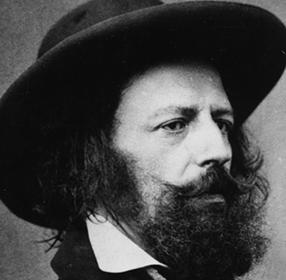
Lord Alfred Tennyson
.
Soms komen werelden bijeen waarvan je misschien niet zo snel verwacht dat ze bij elkaar komen. Dat gevoel kreeg ik toen ik afgelopen week naar de James Bond film Skyfall zat te kijken. M. het grote opperhoofd van de 00 agenten, citeert tijdens een ‘hearing’ door de, voor haar verantwoordelijke, minister een strofe uit het gedicht ‘Ulysses’ van Lord Alfred Tennyson.
Het is overigens niet de eerste keer dat dit gedicht redelijk prominent in een film voorkomt. Al eerder was het te horen in Dead poets society, maar dat is een film (qua titel en inhoud) waar je een dergelijk gedicht eerder verwacht dan in een actiefilm.
Het gebruik van deze strofe sluit echter heel mooi aan bij waar het in deze scene van de film omgaat. Hoewel Ulysses en zijn zeemannen niet meer zo sterk zijn als in hun jeugd, zijn ze “sterk in wil” en worden ondersteund door hun vastberadenheid om verder “meedogenloos te streven, te zoeken, te vinden, en niet toe te geven”.
.
Ulysses
It little profits that an idle king,
By this still hearth, among these barren crags,
Matched with an aged wife, I mete and dole
Unequal laws unto a savage race,
That hoard, and sleep, and feed, and know not me.
I cannot rest from travel;
I will drink Life to the lees.
All times I have enjoyed
Greatly, have suffered greatly, both with those
That loved me, and alone; on shore, and when
Through scudding drifts the rainy Hyades
Vext the dim sea. I am become a name;
For always roaming with a hungry heart
Much have I seen and known–cities of men
And manners, climates, councils, governments,
Myself not least, but honored of them all,–
And drunk delight of battle with my peers,
Far on the ringing plains of windy Troy.
I am a part of all that I have met;
Yet all experience is an arch wherethrough
Gleams that untraveled world whose margin fades
For ever and for ever when I move.
How dull it is to pause, to make an end,
To rust unburnished, not to shine in use!
As though to breathe were life! Life piled on life
Were all too little, and of one to me
Little remains; but every hour is saved
From that eternal silence, something more,
A bringer of new things; and vile it were
For some three suns to store and hoard myself,
And this gray spirit yearning in desire
To follow knowledge like a sinking star,
Beyond the utmost bound of human thought.
This is my son, mine own Telemachus,
To whom I leave the scepter and the isle,
Well-loved of me, discerning to fulfill
This labor, by slow prudence to make mild
A rugged people, and through soft degrees
Subdue them to the useful and the good.
Most blameless is he, centered in the sphere
Of common duties, decent not to fail
In offices of tenderness, and pay
Meet adoration to my household gods,
When I am gone. He works his work, I mine.
There lies the port; the vessel puffs her sail;
There gloom the dark, broad seas.
My mariners, Souls that have toiled, and wrought, and thought with me,
That ever with a frolic welcome took
The thunder and the sunshine, and opposed
Free hearts, free foreheads–you and I are old;
Old age hath yet his honor and his toil.
Death closes all; but something ere the end,
Some work of noble note, may yet be done,
Not unbecoming men that strove with gods.
The lights begin to twinkle from the rocks;
The long day wanes; the slow moon climbs; the deep
Moans round with many voices. Come, my friends,
‘Tis not too late to seek a newer world.
Push off, and sitting well in order smite
The sounding furrows; for my purpose holds
To sail beyond the sunset, and the baths
Of all the western stars, until I die.
It may be that the gulfs will wash us down;
It may be we shall touch the Happy Isles,
And see the great Achilles, whom we knew.
Though much is taken, much abides; and though
We are not now that strength which in old days
Moved earth and heaven, that which we are, we are,
One equal temper of heroic hearts,
Made weak by time and fate, but strong in will
To strive, to seek, to find, and not to yield.
.
Met dank aan http://www.poets.org, sparknotes.com en Youtube.
Everything you’ve always wanted to know about poetry
But were afraid to ask
.
De laatste tijd lees ik nogal veel over poëzie, wat het belang van poëzie is of kan zijn, waar poëzie een positieve invloed op kan hebben, hoe poëzie het leven veraangenaamd en waarom je poëzie zou moeten lezen. In dat kader kwam ik een bijzonder aardig essay tegen van Bill Zavatsky op de website http://www.poets.org/.
De strekking van dit essay is dat het genieten en het waarderen van poëzie in veel gevallen (als daar überhaupt al sprake van is) op scholen en universiteiten stevig wordt tegen gewerkt door het eindeloos analyseren en duiden van poëzie. Elk gedicht wordt uitgebreid besproken, de symboliek in de tekst, de achtergronden, thema’s en dergelijke worden uitgekauwd waardoor er voor het genieten van poëzie eigenlijk geen ruimte wordt gelaten.
Hij schrijft het ook als een aanklacht tegen de docenten die les geven in poëzie : “In “interpreting” poetry, too many teachers have forgotten the great unwritten law of its mathematics: a good poem is always more than the sum of its parts. It is first and last the document of a human experience.”
De weerstand tegen het gebruik van spreektaal of klare taal in poëzie komt ook aan de orde (alsof poëzie alleen maar poëtisch is als je er weinig van begrijpt of moeite voor moet doen). Ik realiseer me dat dit artikel erg op de Amerikaanse situatie is geschreven. Volgens mij zouden we in onze handen moeten knijpen als er les wordt gegeven in poëzie op middelbare scholen. Maar een deel van de kritiek begrijp ik wel.
Zavatsky breekt een lans voor het genieten van poëzie om wat het is. Of in zijn woorden: “Experience is our objective; the interpretation of experience, a natural and laudable human activity, still comes afterwards.”
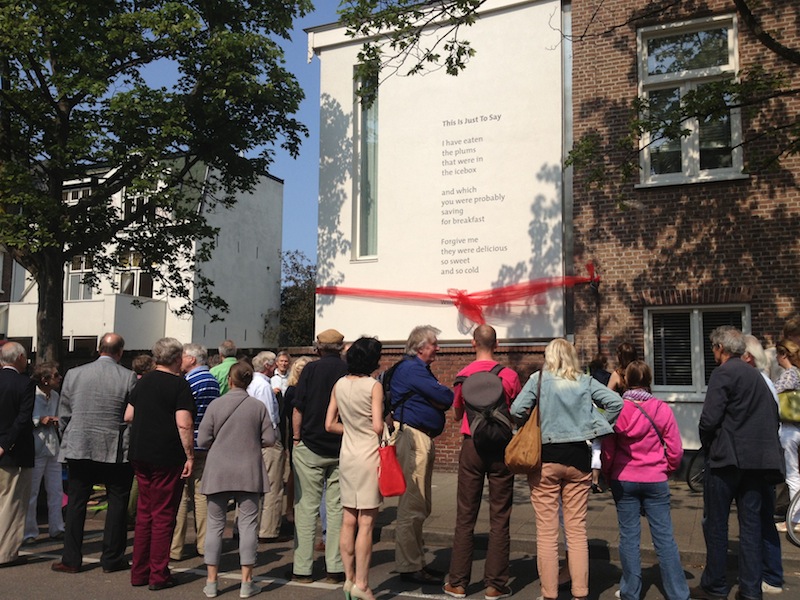
In dit essay geeft hij een voorbeeld van een gedicht in gewone taal. Misschien niet heel toevallig viel mijn oog hierop. Het is een gedicht van William Carlos Williams getiteld ‘This is just to say’ en juist dit gedicht staat op een muur in de buurt van mijn woonhuis in Den Haag.
Hieronder het gedicht en de link naar het essay van Bill Zavatsky.
.
This is just to say
I have eaten
the plums
that were in
the icebox
and which
you were probably
saving
for breakfast
Forgive me
they were delicious
so sweet
and so cold
.
.
Het essay van Zavatsky staat hier: http://www.poets.org/poetsorg/text/everything-you-always-wanted-know-about-poetry




 ZICHTBAAR ALLEEN