Site-archief
Gekozen
Duhita Cori Kresge
.
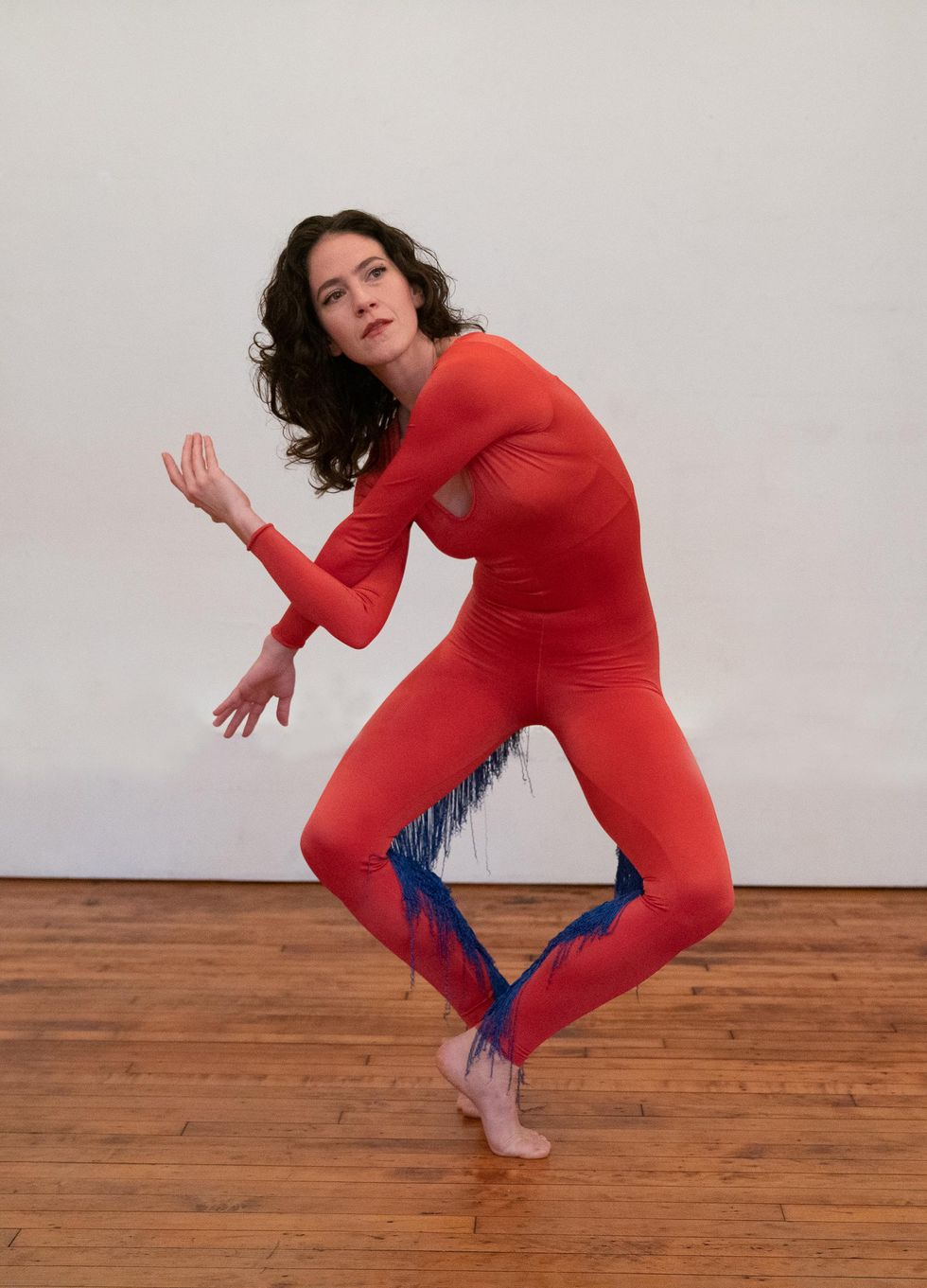
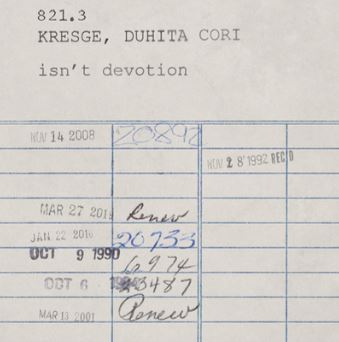
Veel mensen hebben dans omschreven als “poëzie in beweging”. Maar voor de Amerikaanse Cori Kresge gaat de relatie tussen poëzie en dans veel dieper. Deze danseres, schrijfster, dichter, docente en lichaamstherapeute uit New York City debuteerde in 2019 met de bundel ‘Isn’t Devotion’.
Over de bundel en de inhoud zegt ze: “Dertien jaar lang was mijn familie betrokken bij een spirituele sekte die me volledig in beslag nam, me betoverde en me langzaam maar zeker zou hebben vernietigd. Op achttienjarige leeftijd werd ik plotseling en op mysterieuze wijze uit de sekte gezet. De bundel ‘Isn’t Devotion’ is een klein altaartje om de dood van mijn jonge geloof te verwerken. Deze dood is definitief. Daar heb ik voor gezorgd. Ik schreef deze gedichten om mezelf weer toegang te verschaffen tot een wereld die me buitensloot. Deze dichtbundel is een inbreuk op het goddelijke, een lofzang op ongeloof en een voorzichtige poging tot vergeving.”
Over de combinatie van dansen en poëzie zegt ze: “Beide vormen, dansen en poëzie, van communicatie voelen aan als de puurste en meest directe manieren waarop ik kan deelnemen aan een gesprek dat groter is dan mezelf. Ik verlang naar verbinding, naar intimiteit, en dansen en schrijven zijn de manieren waarop ik dat vind. Ik wil in gesprek zijn met de mensheid; ik wil mijn kleine stem toevoegen aan dit veel grotere koor van de waarheid.”
Uit deze bundel nam ik het gedicht ‘Chosen’.
.
Chosen
.
When God wants to gets rid of you
He doesn’t do it Himself
He sends His secretary
she takes you down
into a walk-in freezer
you sit on a white plastic bucket
there are shelves
with gallon jars of rose syrup
mango pickle frozen
cream cheese in bulk
you are tied down by your dress six yards
of imitation silk with floral print snakes
around you getting tighter
the secretary stands close and holds a knife
shaped like a note and a picture of Him
in front of your face and the knife goes slowly
slowly into your ribs until
it’s all the way in
and she says He told me to tell you
He loves you He loves you and He wants you
to carry His love with you far
far away and you say but this will kill me
I will die and you
give the knife back
and God’s secretary says nothing
.
Straatpoëzie in New York
Frank O’Hara
.
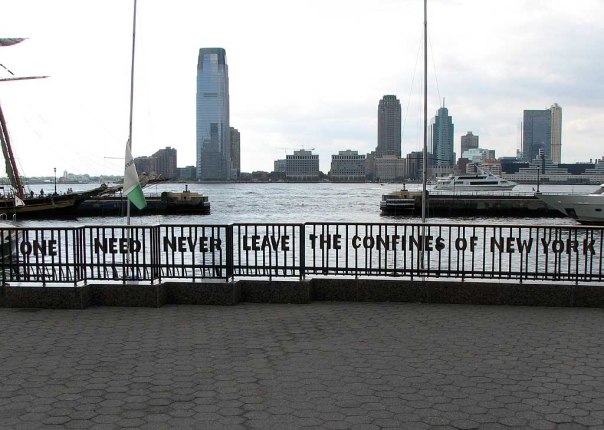
In Nederland (en Vlaanderen) heb je sinds vorig jaar een prachtige website https://straatpoezie.nl waar je een vrij uitputtend overzicht krijgt van alle poëzie die je in de openbare ruimte kan tegenkomen of kan opzoeken. Maar niet alleen in ons land en België bestaat zoiets als poëzie in de openbare ruimte. Zo kwam ik een mooi voorbeeld tegen van regels uit een gedicht van de Amerikaanse Frank O’Hara die zijn aangebracht in een hek in Lower Manhattan langs het water bij Battery Park in de buurt van het World Financial Centre.
Het betreft hier een regel uit het gedicht ‘Meditations in an Emergency’. Frank O’Hara (1926 – 1966) was kunstcriticus, schrijver en dichter die zich veelvuldig liet beïnvloeden door jazz, het surrealisme, het abstract expressionisme, action painting en verschillende avant-garde kunststromingen.
Zijn poëzie heeft een geheel eigen toon en inhoud en werd wel beschreven als dat ze klonk als ‘het begin van een dagboek’. O’Hara zoekt de intimiteit van het leven in zijn poëzie omdat “poëzie zou moeten gaan tussen twee mensen en niet tussen twee bladzijden”. Behalve dat zijn werk heel autobiografisch is, gaat het ook heel erg over New York, de stad waar hij zijn leven lang gewoond heeft. Zijn werk is eigenlijk de vertelling van zijn leven.
Het gedicht ‘Meditations in an Emergency’ is uit 1957.
.
Meditations in an Emergency
.
Am I to become profligate as if I were a blonde? Or religious as if I were French?
Each time my heart is broken it makes me feel more adventurous (and how the same names keep recurring on that interminable list!), but one of these days there’ll be nothing left with which to venture forth.
Why should I share you? Why don’t you get rid of someone else for a change?
I am the least difficult of men. All I want is boundless love.
Even trees understand me! Good heavens, I lie under them, too, don’t I? I’m just like a pile of leaves.
However, I have never clogged myself with the praises of pastoral life, nor with nostalgia for an innocent past of perverted acts in pastures. No. One need never leave the confines of New York to get all the greenery one wishes—I can’t even enjoy a blade of grass unless I know there’s a subway handy, or a record store or some other sign that people do not totally regret life. It is more important to affirm the least sincere; the clouds get enough attention as it is and even they continue to pass. Do they know what they’re missing? Uh huh.
My eyes are vague blue, like the sky, and change all the time; they are indiscriminate but fleeting, entirely specific and disloyal, so that no one trusts me. I am always looking away. Or again at something after it has given me up. It makes me restless and that makes me unhappy, but I cannot keep them still. If only I had grey, green, black, brown, yellow eyes; I would stay at home and do something. It’s not that I am curious. On the contrary, I am bored but it’s my duty to be attentive, I am needed by things as the sky must be above the earth. And lately, so great has theiranxiety become, I can spare myself little sleep.
Now there is only one man I love to kiss when he is unshaven. Heterosexuality! you are inexorably approaching. (How discourage her?)
St. Serapion, I wrap myself in the robes of your whiteness which is like midnight in Dostoevsky. How am I to become a legend, my dear? I’ve tried love, but that hides you in the bosom of another and I am always springing forth from it like the lotus—the ecstasy of always bursting forth! (but one must not be distracted by it!) or like a hyacinth, “to keep the filth of life away,” yes, there, even in the heart, where the filth is pumped in and courses and slanders and pollutes and determines. I will my will, though I may become famous for a mysterious vacancy in that department, that greenhouse.
Destroy yourself, if you don’t know!
It is easy to be beautiful; it is difficult to appear so. I admire you, beloved, for the trap you’ve set. It’s like a final chapter no one reads because the plot is over.
“Fanny Brown is run away—scampered off with a Cornet of Horse; I do love that little Minx, & hope She may be happy, tho’ She has vexed me by this Exploit a little too. —Poor silly Cecchina! or F:B: as we used to call her. —I wish She had a good Whipping and 10,000 pounds.” —Mrs. Thrale.
I’ve got to get out of here. I choose a piece of shawl and my dirtiest suntans. I’ll be back, I’ll re-emerge, defeated, from the valley; you don’t want me to go where you go, so I go where you don’t want me to. It’s only afternoon, there’s a lot ahead. There won’t be any mail downstairs. Turning, I spit in the lock and the knob turns.
.





 ZICHTBAAR ALLEEN