Site-archief
Ken je mij
Huub Oosterhuis
Gisteravond keek ik naar een programma over Marco Borsato. In dat programma kwam een lied voor van Trijntje Oosterhuis. Nu ben ik geen fan van Trijntje Oosterhuis maar dit vond ik een mooi lied. Waarschijnlijk door de tekst van het lied, geschreven door haar vader Huub Oosterhuis.
De poëtische tekst van ‘Ken je mij’, bevat pareltjes van zinnen. Daarom hier de tekst van het gedicht.
.
Ken je mij
Ken je mij? Wie ken je dan?
Weet jij mij beter dan ik?
Ken je mij? Wie ben ik dan?
Weet jij mij beter dan ik?
Ogen die door de zon heen kijken
Zoekend naar de plek waar ik woon
Ben jij beeldspraak voor iemand
die aardig is, of onmetelijk ver,
die niet staat en niet valt
en niet voelt als ik,
niet koud en hooghartig
Hier is de plek waar ik woon
Een stoel op het water,
Een raam waarlangs het opklarend weer
Of het vallende duister voorbij vaart
Heb je geroepen? Hier ben ik
Ik zou een woord willen spreken
Dat waar en van mij is
Dat draagt wie ik ben,
dat het houdt,
Ik zou een woord willen spreken
Dat rechtop staat als mens die mij aankijkt en zegt
Ik ben jouw zuiverste zelf,
Vrees niet, versta mij, ik ben, ik ben
Ben jij de enige voor wiens ogen
Niet is verborgen van mijn naaktheid
Kan jij het hebben,
Als niemand anders,
Dat ik geen licht geef, niet warm ben,
Dat ik niet mooi ben, niet veel
Dat geen bron ontspringt
in mijn diepte
Dat ik alleen dit gezicht heb,
geen ander.
Ben ik door jou, zonder schaamte,
gezien, genomen,
door niemand minder?
Zou dat niet veel teveel waar zijn?
Zou dat niet veel teveel waar zijn?

Dotan
Hungry
.
Sommige muziek klinkt mij als poëzie in de oren. Dit komt meestal door de combinatie van bepaalde zinnen of teksten en de muziek die er bij hoort. Dit is ook het geval bij het nummer ‘Hungry’ van Dotan van zijn album ‘7 Layers’. De zanger Dotan is veel in het nieuws (zijn nummer ‘Home’ werd door 3FM gekozen tot song van het jaar 2014) en niet ten onrechte. Een zin als “It’s a hive of honeybees trapped inside of our skin / Growing faster, stinging harder till we all give in” zou zo uit een gedicht kunnen komen.
Alleen om die twee zinnen al wil ik de tekst van dit nummer met jullie delen. Volgens Dotan gaat dit nummer over de liefde, over het feit dat we niet zonder maar ook net zo vaak niet met de liefde kunnen leven.
.
Hungry
Hit up the bottom,hearts will melt like ice
As the lights keep falling, makes you feel so small again
As we walk in circles, the blind leading the blight
No way of hiding, our heart is all we got
I’m hungry for you, my love, so come out and rescue me
Love is just not enough out in this war of needs
Drag your heart to the place where it belongs
While it’s underwater, where my love will fill your bones
The clouds are shaking, and your palms began to crack
Hands against your eyes, see this love is all we got
I’m hungry for you, my love, so come out and rescue me
Love is just not enough out in this war of needs
It’s a hive of honeybees trapped inside of our skin
Growing faster, stinging harder till we all give in
oh, oh, oh oh oh oh
oh, oh, oh oh oh oh
oh, oh, oh oh oh oh
oh, oh, oh oh oh oh
I’m hungry for you, my love
Love is just not enough
I’m hungry for you, my love
Love is just not enough
I’m hungry for you, my love, so come out and rescue me
Love is just not enough out in this war of needs
I’m hungry for you, my love, so come out and rescue me
If love is just not enough out in this war of needs
I’m hungry for you, my love
Love is just not enough
It’s a hive of honeybees trapped inside of our skin
Growing faster, stinging harder till we all give in
.

Yellow Ledbetter
Pearl Jam
.
Soms vraag je je af bij poëzie waar een gedicht of een tekst over gaat. In een aantal gevallen gaat poëzie ‘nergens over’ maar is de klank van een gedicht of de muzikaliteit, het ritme en de loop van de tekst belangrijk en niet zozeer de tekst zelf (zeer bekend voorbeeld Oote van Jan Hanlo). In de muziek komt dit ook voor en dan wordt dit meestal versterkt door de instrumenten die daarbij gebruikt worden.
In het nummer Yellow Ledbetter van Pearl Jam is de tekst ook niet of nauwelijks relevant. Op dit nummer improviseert Eddie Vedder de tekst in woorden en zinnen die schijnbaar geen relevantie hebben maar als je dan goed tussen de regels doorleest lijkt het toch misschien ergens over te gaan.
Op de zeer informatieve website http://songmeanings.com/ staat over dit nummer te lezen:
For the most part the lyrics in this song are irrelevant. The song was written by Mike McCready and Eddie just made up the words as he went along. Eddie’s voice is supposed to be more of an instrument by using improvised words, the words are never the same in concert. Ledbetter refers to Eddie’s friend from Chicago named Tim Ledbetter. If there is any meaning to the lyrics I think the letter in the beginning of the song refers to the telegrams that we sent to the families of soldiers KIA in WWII. The telegrams were so distinct that many families didn’t have to open them to know what they said. In the song I see a family sitting on a porch when a man comes to deliver a telegram and the family is so devestated about their loss that they cannot even bear to open it.
De stem van de zanger dus als extra instrument, of als ‘ poëtisch kunstwerk’ te plaatsen in de categorie waarin ook zovele gedichten vallen die schijnbaar zonder een duidelijk onderwerp zijn.
Hier de tekst en het nummer.
.
Yellow Ledbetter
Unsealed
On a porch a letter sat
Then you said I want to leave it again
Once I saw him
On a beach of weathered sand
And on the sand I want to leave it again
On a weekend want to wish it all way
And they called an I said an I want what
I said an I call out again
And the reason oughta leave her calm I know
I said I know what I wear that a box or the bag
Oh yeah can you see them?
Out on the porch
Ah, but they don’t wave
I see them
Round the front way, yeah
And I know and I know
I don’t want to stay
Make me cry
I see
I don’t know there’s something else
I want to drum it all away
An I said
“I don’t, I don’t know whether I was the boxer or the bag”
Oh yeah can you see them?
Out on the porch
Ah, but they don’t wave
I see them
Round the front way, yeah
And I know and I know
I don’t want to stay
I don’t want to stay
I don’t want to stay
.

.
Fix you
Coldplay
.
In het kader van poëzie en muziek én in de sfeer van kerst vandaag een nummer van Coldplay ‘Fix you’ van hun album ‘X & Y’ uit 2005. De tekst mag als zodanig misschien niet iedereen meteen aanspreken of heel poëtisch zijn maar in combinatie met de muziek is het zeer de moeite waard.
Tijdens het schrijven van het nummer was zanger Chris Martin beïnvloed door de band Muse, die een kerkorgel gebruikten in hun nummer “Megalomania” (van het album Origin of Symmetry). Omdat geluid na te maken gebruikte hij een oud keyboard dat Bruce Paltrow had gegeven aan Martins vrouw Gwyneth Paltrow. Martin heeft echter ook vaak gezegd dat het nummer een kopie is van Elbows ‘Grace under pressure’.
Het is het enige nummer van Coldplay waarin alle 4 de bandleden tegelijk zingen.
.
Fix you
When you try your best but you don’t succeed
When you get what you want but not what you need
When you feel so tired but you can’t sleep
Stuck in reverse
And the tears come streaming down your face
When you lose something you can’t replace
When you love someone but it goes to waste
Could it be worse?
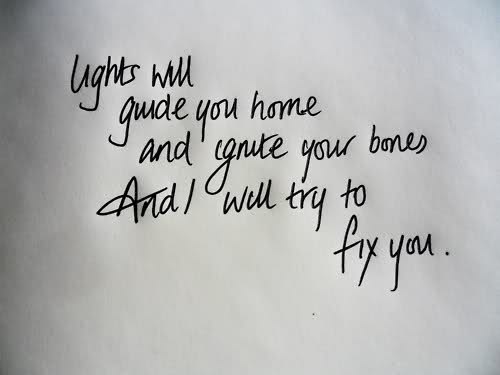
Lights will guide you home
And ignite your bones
And I will try to fix you
And high up above or down below
When you’re too in love to let it go
But if you never try you’ll never know
Just what you’re worth
Lights will guide you home
And ignite your bones
And I will try to fix you
Tears stream down your face
When you lose something you cannot replace
Tears stream down your face
And I
Tears stream down your face
I promise you I will learn from my mistakes
Tears stream down your face
And I
Lights will guide you home
And ignite your bones
And I will try to fix you
.

Waltzing Matilda
Tom Waits
.
Teksten van liedjes hebben vaak een poëtische waarde. Tekstdichters zijn soms ook goede dichters. Een voorbeeld van een poëtische tekst is de tekst van Waltzing Matilda van Tom Waits.
‘Tom Traubert’s blues’, zoals de officiële titel van ‘Waltzing Matilda’ luidt komt van zijn album ‘Small Change’ uit 1976 en is een verwijzing naar een populair Australisch volksliedje waarvan de melodie dan weer van een Schots liedje is. In het nummer van Tom Waits is het een mogelijke verwijzing naar alcoholmisbruik of het spuiten van heroïne, zoals de militairen het noemde tijdens de Vietnamoorlog.
Waltzing Matilda
Wasted and wounded
And it ain’t what the moon did
I got what I paid for now
See you tomorrow
Hey Frank can I borrow
A couple of bucks from you
To go waltzing Matilda waltzing Matilda
You’ll go waltzing Matilda with me
I’m an innocent victim
of a blinded alley
And I’m tired of all these soldiers here
No-one speaks English
And everything’s broken
And my strength is soaking away
To go waltzing Matilda, waltzing Matilda
You’ll go a waltzing Malitda with me
Now the dogs they are barking
and the taxi cab’s parking
A lot they can do for me
I begged you to stab me
You tore my shirt open
And I’m down on my knees tonight
Old bushmills I staggered
You buried the dagger
Your silhouette window light
To go waltzing Matilda, waltzing Matilda
You’ll go a waltzing Matilda with me
Now I’ve lost my St. Christopher
Now that I kissed her
And the one-arm bandit knows
And the maverick Chinaman
with the cold-blooded sigh
And the girls down by the striptease shows go
Waltzing Matilda, waltzing Matilda
You’ll go a waltzing Matilda with me
No I don’t want your sympathy
Fugitives say
that the streets aren’t for dreaming now
Manslaughter dragnet
and the ghost that sells memories
Want a piece of the action anyhow
Go waltzing Matilda, waltzing Matilda
You’ll go waltzing Matilda with me
And you can ask any sailor
And the keys from the jailor
And the old men in wheelchairs know
That Matilda’s the defendant
She killed about a hundred
And she follows wherever you may go
Waltzing Matilda, waltzing Matilda
You’ll go waltzing Matilda with me
And it’s a battered old suitcase
in a hotel someplace
And a wound that would never heal
No prima donnas the perfume is on
and old shirt that is stained with blood and whiskey
And goodnight to the street-sweepers,
The night watchmen flame-keepers
And goodnight Matilda too
Goodnight Matilda too.
A Poem on the Underground Wall
Simon & Carfunkel
.
Sommige liedjes hebben niet alleen een poëtische tekst of zijn poëtisch van aard, een enkele gaat ook over poëzie zoals het nummer van Simon & Carfunkel uit 1966 ‘A Poem on the Underground Wall’. Dit nummer werd geschreven door Paul Simon en verscheen op het album ‘Parsley, Sage, Rosemary and Thyme’.
Hoewel het nummer maar 1 minuut 52 seconden duurt verteld het liedje een heel verhaal. De anekdote over dit nummer is dat de fotoshoot voor de cover van het album op een vroege woensdagochtend (3 uur) werd verpest, omdat de muur van de metro, die ze wilden gebruiken als achtergrond, was bekalkt met allerlei obscene teksten.
.
.
A Poem On The Underground Wall
.
The underground is closing soon,
And in the dark deserted station,
Restless in anticipation,
A man waits in the shadows.
.
His restless eyes leap and scratch,
At all that they can touch or catch,
And hidden deep within his pocket,
Safe within its silent socket,
He holds a colored crayon.
.
Now from the tunnel’s stony womb,
The carriage rides to meet the groom,
And opens wide and welcome doors,
But he hesitates, then withdraws
Deeper in the shadows.
.
And the train is gone suddenly
On wheels clicking silently
Like a gently tapping litany,
And he holds his crayon rosary
Tighter in his hand.
.
Now from his pocket quick he flashes,
The crayon on the wall he slashes,
Deep upon the advertising,
A single worded poem comprised
Of four letters.
.
And his heart is laughing, screaming, pounding
The poem across the tracks rebounding
Shadowed by the exit light
His legs take their ascending flight
To seek the breast of darkness and be suckled by the night.
Suzanne Vega
Poëzie in muziek
.
De zangeres Suzanne Vega is vooral bekend als zangeres van hits als ‘Luka’, ‘Tom’s diner’ en ‘Left of center’. Wat minder bekend is, is dat ze ook gedichten schrijft en verhalen.
Zo verscheen van haar in 1999 het boek “The Passionate Eye: The Collected Writing of Suzanne Vega” met daarin verhalen, herinneringen, gedichten en songteksten. Op haar officiële website is zelfs een pagina besteed aan gedichtjes uit haar jeugd. Daar kun je al lezen dat ze op zeer jonge leeftijd talent had voor taal.
Haar jeugdpoëzie staat op http://www.suzannevega.com/suzannes-childhood-poems/
Maar ook in de teksten van haar liedjes blijkt een poëtisch taalgevoel. Hieronder de tekst van een van haar grootste hits Luka.
.
Tom’s Diner
I am sitting
In the morning
At the diner
On the corner
I am waiting
At the counter
For the man
To pour the coffee
And he fills it
Only halfway
And before
I even argue
He is looking
Out the window
At somebody
Coming in
“It is always
Nice to see you”
Says the man
Behind the counter
To the woman
Who has come in
She is shaking
Her umbrella
And I look
The other way
As they are kissing
Their hellos
I’m pretending
Not to see them
Instead
I pour the milk
I open
Up the paper
There’s a story
Of an actor
Who had died
While he was drinking
It was no one
I had heard of
And I’m turning
To the horoscope
And looking
For the funnies
When I’m feeling
Someone watching me
And so
I raise my head
There’s a woman
On the outside
Looking inside
Does she see me?
No she does not
Really see me
Cause she sees
Her own reflection
And I’m trying
Not to notice
That she’s hitching
Up her skirt
And while she’s
Straightening her stockings
Her hair
Has gotten wet
Oh, this rain
It will continue
Through the morning
As I’m listening
To the bells
Of the cathedral
I am thinking
Of your voice…
And of the midnight picnic
Once upon a time
Before the rain began…
I finish up my coffee
It’s time to catch the train
.
Elvis Costello
She
.
Hoewel het liedje ‘She’ vooral beroemd is gemaakt door Charles Aznavour (1974) deed ook Elvis Costello een aardige duit in het zakje als het gaat om dit lied nog beroemder te maken dan het al was middels zijn vertolking in de film ‘Notting Hill’ uit 1999 met Hugh Grant en Julia Roberts. Persoonlijk prefereer ik de versie van Elvis maar dat komt vooral omdat ik Elvis Costello al vanaf zijn debuut album ‘My Aim is True’ een geweldig muzikant vind.
Hoewel ook op dat album (en op veel van zijn latere werk) prachtige liedteksten zijn te vinden vandaag de tekst van ‘She’, geschreven door Charles Aznavour en Herbert Kretzmer.
.
She
.
She
May be the face i can’t forget
A trace of pleasure or regret
May be my treasure or the price i have to pay
She may be the song that summer sings
May be the chill that autumn brings
May be a hundred different things
Within the measure of a day.
.
She
May be the beauty or the beast
May be the famine or the feast
May turn each day into a heaven or a hell
She may be the mirror of my dreams
A smile reflected in a stream
She may not be what she may seem
Inside her shell
.
She who always seems so happy in a crowd
Whose eyes can be so private and so proud
No one’s allowed to see them when they cry
She may be the love that cannot hope to last
May come to me from shadows of the past
That i’ll remember till the day i die
.
She
May be the reason i survive
The why and wherefore i’m alive
The one i’ll care for through the rough and ready years
Me i’ll take her laughter and her tears
And make them all my souvenirs
For where she goes i’ve got to be
The meaning of my life is
.
She, she, she
.
Bij een slapend lichaam
Serge R. van Duijnhoven
.
Het mooie van een blog hebben (en de daarbij behorende lezers uiteraard) is dat je naar aanleiding van de dingen die je schrijft soms hele aardige en bijzondere tips en verwijzingen krijgt. Zo reageerde Serge R. van Duijnhoven (van Dichters dansen niet)op een bericht van mij waarin de link tussen muziek en poëzie wordt beschreven (categorie Poëzie en songteksten).
Het gaat om het volgende gedicht.
.
Bij een slapend lichaam
ik wil dat je mijn bedoelingen doorgrondt
ik wil dat je de prijs leert kennen van verlangen
de schaal van de dingen, ik wil dat je begrijpt
waarom men het aardige overwaardeert
ik wil je horen zeggen:
‘alles dient slechts om te winnen
alles is tactiek; wij spelen
allemaal’
ik wil dat men ons geheim zal bewaren
dat we elkaar geruisloos achtervolgen als jagers
ik wil dat we bereid zijn onze ziel in te zetten
zoals we een munt inwerpen bij een gokautomaat
ik wil de tijd terug dat ik wijs werd uit mijn dromen
ik wil de tekens terug die ik heb nagelaten op je huid
ik wil je kunnen voelen met mijn ogen in het donker
met mijn nagels nagaan waar je bent geweest
ik wil dat jouw handen me in koele lakens wikkelen
ik wil zien of jouw zijde van de mijne verschilt
ik wil dat je sterker zal zijn naar het einde
ik wil je laten denken dat je wint
ik wil dat je je zonder mij een vondelinge voelt
een zonderlinge in de leegte, ik wil je zien bibberen
in de kou. Ik wil je zwetend, warmgewreven
ik wil je hondsdol, biddend om berouw
ik wil dat je mijn gedachten kunt lezen
ik wil dat je mijn hart kunt raken
of de fatale plek. Het interesseert met niet
wie de wonden veroorzaakt. Het interesseert me niet
hoeveel het er zijn. Ik wil alleen belang stellen
in wat me beheerst. Ik wil op een prachtige plek zijn
als ik sterf. Ik wil kunnen verdrinken in een Rode Zee
me verwonden aan een giftig koraal, aanspoelen
op een hagelwit strand, met jouw smaak nog
op mijn lippen. Ik wil je niet kapotmaken
ik zou niet weten hoe. Kon ik maar zeggen:
ik zal je vergeten. Kon ik maar zeggen:
ik laat je met rust
maar liegen kan ik niet
ik denk altijd aan je, echt waar
ik zal voor altijd aan je denken
.
Serge schrijft over dit gedicht:
“Oorspronkelijk ontstond “Bij een slapend lichaam” als het resultaat van een soort gedachten experiment. Een vraag die ik in een gedicht verder uit wilde zoeken:
wat als de driften van een minnaar niet meer beteugeld kunnen worden. En hij in een onbezonnen vlaag van passie, razernij en bezitsdrang het object van zijn begeerte letterlijk laat stikken? Wat zou deze excessieve minnaar denken, doen en willen zeggen terwijl hij neerknielt bij het lichaam van zijn geliefde? Schiet hij in de kramp der ontkenning, wat ik vermoed, of breken de sluizen van zijn emotie en het zelfinzicht alsnog open? Wat zouden zijn laatste woorden tot haar zijn, alvorens hij de deur van haar slaapkamer zal vergrendelen? En hij met onbegrijpelijk kalme tred van de trap in haar studentenhuis afdaalt?
Over het algemeen reageren toehoorders teleurgesteld of zelfs gebeten wanneer ze van deze ontstaansgeschiedenis horen. Degenen die het gedicht dierbaar is, voelen zich bedrogen. Terwijl ik van mening ben dat ik de luisteraar pas echt zou bedotten als ik hier niets over zou vertellen. Ik neem het publiek, zo kun je wel stellen, dus juist in vertrouwen in plaats van het te bedriegen. En al is dit uitgangspunt niet iets wat de meeste mensen perse willen of hoeven te weten, waar is het wel.”
.
Dit gegeven is denk ik voor vele dichters bekend. Je schrijft een gedicht en uit de reacties van lezers en toehoorders krijg je terug waarover (zij denken) dat het gedicht gaat. Dit kan enorm afwijken van de bedoeling van de dichter. Volgens mij is dat juist de charme van poëzie, iedereen kan er in lezen wat hij/zij wil terwijl de dichter er wellicht iets heel anders mee bedoelde.
Van dit gedicht is een filmpje gemaakt “Zomaar goed” dat Henk Hofstede maakte voor het album en de theatershow “Prettige vooruitzichten” (2010) van Rick Treffers. Serge voegt daar nog aan toe:
Als tekstuele toevoeging aan dit knappe en gelaagde symfonische lied, dat te horen is op Treffer’s album “Prettige vooruitzichten” (2011), leest de dichter vanuit de coulissen bovenstaand gedicht voor. Als ware het een laatste groet aan een geliefde die achterblijft in bed. Op de drempel tussen nacht en dag, verleden en heden, wanhoop en begeerte, liefde en bezitsdrang.
.
.
Leonard Cohen
Suzanne
.
De scheidingslijn tussen poëzie en songteksten is soms heel klein (vaak ook heel groot trouwens) en er zijn songteksten die je kunt lezen als gedichten. Een aantal tekstdichters zijn ook bekend als dichter en een mooi voorbeeld is Leonard Cohen. Daarom hieronder de tekst van één van zijn bekendste en mooiste nummers Suzanne uit 1966.
In de komende tijd zal ik wat vaker aandacht besteden aan songteksten die opvallen door hun poëtische taalgebruik.
.
Suzanne
.
Suzanne takes you down to her place near the river
You can hear the boats go by
You can spend the night beside her
And you know that she’s half crazy
But that’s why you want to be there
And she feeds you tea and oranges
That come all the way from China
And just when you mean to tell her
That you have no love to give her
Then she gets you on her wavelength
And she lets the river answer
That you’ve always been her lover
And you want to travel with her
And you want to travel blind
And you know that she will trust you
For you’ve touched her perfect body with your mind.
And Jesus was a sailor
When he walked upon the water
And he spent a long time watching
From his lonely wooden tower
And when he knew for certain
Only drowning men could see him
He said “All men will be sailors then
Until the sea shall free them”
But he himself was broken
Long before the sky would open
Forsaken, almost human
He sank beneath your wisdom like a stone
And you want to travel with him
And you want to travel blind
And you think maybe you’ll trust him
For he’s touched your perfect body with his mind.
.
Now Suzanne takes your hand
And she leads you to the river
She is wearing rags and feathers
From Salvation Army counters
And the sun pours down like honey
On our lady of the harbour
And she shows you where to look
Among the garbage and the flowers
There are heroes in the seaweed
There are children in the morning
They are leaning out for love
And they will lean that way forever
While Suzanne holds the mirror
And you want to travel with her
And you want to travel blind
And you know that you can trust her
For she’s touched your perfect body with her mind.
.





 ZICHTBAAR ALLEEN