Site-archief
You mean Donald?
Bart Chabot
.
Op het moment lees ik de columns van Bart Chabot gebundeld in ‘Scheveningse wolken’. Door deze korte verhaaltjes te lezen krijg ik vanzelf weer zin om zijn poëzie erbij te pakken. Daarom vandaag een gedicht van Bart uit ‘Greatest hits, volume 1’ uit 2004.
.
Eend
.
disneyland paris bestaat vijf jaar
er valt confetti uit de wolken
we zitten aan de lunch
in het new york hotel
sebastiaan en ik lopen naar het buffet
ik til het deksel op
van een enorme vleesschotel
– pap – vraagt sebas – is dat kip?
van de damp beslaat mijn bril
– that’s duck sir – schiet een ober ons te hulp
het tafelzilver hangt plotseling
op eigen kracht in de lucht
– you mean donald? – vraag ik
wijzend op de eendenborstjes
stilte daalt over de tafels
dan stijgt homerisch gelach op
sebastiaan kijkt niet blij
.

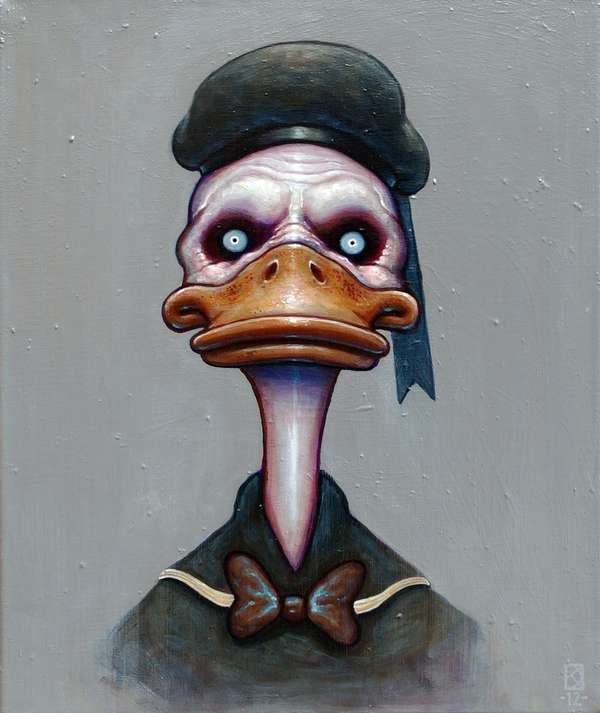
Donald Duck door Daniel Karlsson Renders
Bomen
B. Zwaal
.
ik was de linde toegedaan maar eerde ook de beuk
en in min was ik met de eiken en ’t overspel
bracht mij naar de wilgen waar ik mij beknotte
toen zij hun kronen streken
maar in nam mij
de waardin
die achter ’t knotveer dranken dreef
zo gul van slok en in haar schenken onbedaarlijk
klonk zij als golfslag van een kribbende rivier
en ’t sloeg het bijlen van de bomen
.
Uit: Een drifter, Querido, 2004
.
Dichters en muzikanten
Muziekweb
.
Muziekweb is de website van de Centrale Discotheek Rotterdam (CDR). De CDR is bekend als de muziekcollectie van Nederland en heeft op haar website veel informatie over muziek. Niet alleen over haar collectie en hoe hiervan gebruik te maken maar ook over verschillende stijlen en thema’s.
Een van de thema’s is Dichters & muzikanten. Zoals de tekst op de website al vermeldt, muzikanten en dichters zijn vaak elkaar creatieve partners. Tekstdichters zijn vaak net dichters en dichters zijn soms ook tekstdichters. In de categorie Muziek en Poëzie in songteksten heb ik hier al vele malen over geschreven.
De themafolder Dichters & Muzikanten bevat een aantal bijzondere samenwerkingsvormen van muzikanten en dichters door de tijden heen vanaf 1945 (Willem Pijper en Simon Vestdijk) tot 2012 (Willem Elsschot en Ella Bandita) maar ook de voormalige Rotterdamse stadsdichters De Woorddansers (2007), J.J. Slauerhoff en Nynke Laverman (2004) en Jules Deelder en Herman Brood (1996). In totaal worden 12 bijzondere vormen van samenwerking behandeld.
Van dit thema is een folder gemaakt (te krijgen via elke bibliotheek) die digitaal te lezen is op http://www.muziekweb.nl/Link/N00000000026
Van elk duo zijn geluidsfragmenten te beluisteren en is een discografie opgenomen.
.

Ben Cami
(Bijna) vergeten dichters
.
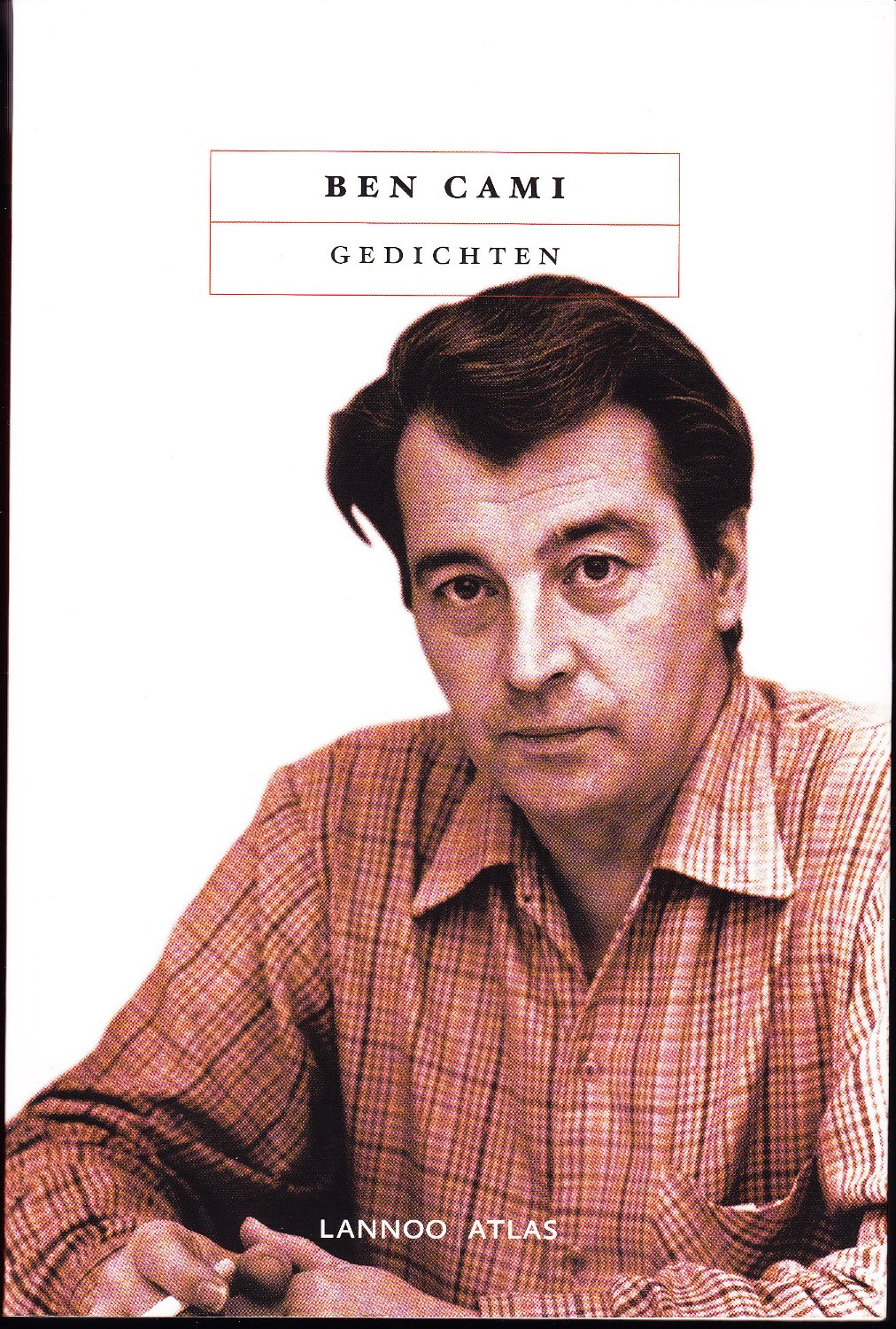
In de categorie vandaag de (bijna) vergeten dichter Ben Cami (1920 – 2004). Ben Cami werd in Engeland geboren maar verhuisde al heel snel met zijn ouders naar België. Na zijn opleiding tot regent Germaanse talen in Gent, was hij tot aan zijn pensioen in 1975 werkzaam als leraar in o.a. Lennik en Geraardsbergen. Via Louis Paul Boon, die bij hem in de klas zat, kwam hij in contact met Jan Walravens (belangrijk in Vlaanderen als literair theoreticus en belangrijk voor het doordringen van het existentialisme in Vlaanderen). In 1938 (Ben moest nog 18 worden) wordt het gedicht ‘Het menschdom marscheert’ onder pseudoniem (Johan Benth) gepubliceerd in de literaire rubriek van het Socialistische dagblad Vooruit.
Na zijn studie Germaanse talen is Cami tot 1975 leraar aan verschillende rijksscholen. Hij was vervolgens een van de oprichters van het experimentele Vlaamse tijdschrift Tijd en Mens. Hij zat in de redactie met onder andere Louis Paul Boon, Jan Walravens en Hugo Claus. In 1950 debuteerde Cami met de poëziebundel ‘In de tijd verloren’, waarna hij diverse werken uitbracht met daarin een boodschap van protest. Cami schreef overwegend poëzie, maar ook aforismen en korte verhalen.
.
Dertig seconden voor je hart stilviel Dertig seconden voor je hart stilvielSprak je, dacht je, en waar sterf je nu,
Waar zwerft
Het onomschrijfbare dat je nu bent? Welke agonie leeft nu stom
In je dode tong en lip?
Je wil ons horen,
Je wil ons zien. Ik neem je bijna koude hand.
Als je me voelt, ben ik ijs
Tegen het ijs van je eenzaamheid. .
Uit: Ten Westen van Eeden uit 1998
.
Met dank aan Wikipedia en Schrijversgewijs.be
Het leven van alledag in poëzie
Americain Life in Poetry
.
In de verenigde Staten is The Poetry Foundation samen met the Library of Congress het project ‘ Life in Poetry’ begonnen tussen 2004 en 2006. De initiatiefnemer was Poet Laureate Consultant bij de Library of Congress. Ted Kooser.
American Life in Poetry ( http://www.americanlifeinpoetry.org) is een gratis wekelijkse column voor kranten en online publicaties waarin een gedicht centraal staat van een modern Amerikaans dichter. Daarnaast wordt er een korte introductie gegeven van de dichter door Ted Kooser. De missie van dit project is om poëzie te promoten. Er zijn geen kosten aan verbonden zolang kranten en online publicaties de tekst in zijn geheel overnemen inclusief de copyrightregels die onder de teksten staan. American Life in Poetry heeft ook een Facebookpagina: https://www.facebook.com/americanlifeinpoetry
Hieronder een mooi voorbeeld, column nummer 155 (van de inmiddels 441) met een gedicht van Marianne Boruch.
.
The American poet Elizabeth Bishop often wrote of how places—both familiar and foreign—looked, how they seemed. Here Marianne Boruch of Indiana begins her poem in this way, too, in a space familiar to us all but made new—made strange—by close observation.
.
Hospital
.
.
American Life in Poetry is made possible by The Poetry Foundation (www.poetryfoundation.org), publisher of Poetry magazine. It is also supported by the Department of English at the University of Nebraska-Lincoln. Poem copyright ©2006 by Marianne Boruch, whose most recent book of poetry is Grace, Fallen from, Wesleyan University Press, 2008. Poem reprinted from “TriQuarterly,” Issue 126, by permission of Marianne Boruch. Introduction copyright © 2013 by The Poetry Foundation. The introduction’s author, Ted Kooser, served as United States Poet Laureate Consultant in Poetry to the Library of Congress from 2004-2006. We do not accept unsolicited manuscripts.
Limericks
Versvormen in meerdere talen
.
Een limerick is een dichtvorm van 5 regels met een vrij strak metrum. Twee drievoetige amfibrachen ( De amfibrachys is een versvoet die bestaat uit een onbeklemtoonde, daarna een beklemtoonde en dan een onbeklemtoonde lettergreep), twee regels amfibrachen en jambe en afgesloten door weer een drievoetige amfibrachen.
In de eerste regel wordt (meestal) een persoon of dier geïntroduceerd met een plaatsnaam, voorts heeft de Limerick vaak een wat dubbelzinnige inhoud, of kan zelfs zeer grof zijn.
Deze vorm van ‘light verse’ werd vooral beroemd gemaakt door de Engelse nonsensdichter Edward Lear (1812-1888) met limericks als deze:
There was an old man with a beard
Who said, ‘It is just as I feared!
Two owls and a hen
Four larks and a wren
Have all build their nest in my beard!
.
Hieronder een aantal Limericks in verschillende talen.
.
Heinz Boenert (1924- )
Laut schimpfte ein alter Pariser:
“Der Lebensstil wird immer mieser!
Die Leut’sind versessen
auf Saufen und Fressen,
wo gibt es noch wahre Genießer?”
.
A wonderful bird is the Pelican.
His beak can hold more than his belly can.
He can hold in his beak
Enough food for a week!
But I’ll be darned if I know how the hellican
.
C’était un brave type de France
N’avait jamais eu n’once de chance
Il jouait au lotto
Avec son pote Otto
Tous deux n’y paumèr’nt pas que finances
.
Reinhard Döhl (1934-2004)
ein mann aus schwäbisch gmund
hielt sich im hintergrund
und das so sehr
und täglich mehr
bis völlig er drin verschwund
.
Aramis
Elvis bleef ongelooflijk discreet
ofschoon hij sterk aan zijn stoelgang leed.
In God’s latrines
krijsen blondines
non-stop zijn “IT’S NOW OR NEVER !”-kreet.
.
Een mollige call-girl te Hijken,
Bereid met haar volheid te prijken,
Laat haar klanten gewoon
Via beeldtelefoon
Een tijdlang haar call-trui bekijken.
.

Met dank aan gedichten.nl, Meandermagazine.net en poezie-in-beweging.nl
The Notebook
Poëzie en Film
.
In de film ‘The Notebook’ van Nick Cassavetes uit 2004 naar een boek van Nicholas Sparks. In de hoofdrollen zijn Ryan Gosling en Rachel McAdams te zien naast Gena Rowlands en James Garner. Leuk weetje is dat de twee hoofdrolspelers in 2005 bij de MTV movie awards de prijs wonnen voor beste kus.
Het verhaal van de film gaat over verloren liefdes en in de film zijn twee gedichten van Walt Whitman verwerkt; ‘Spontaneous me’ en ‘So long’ .
.
So long!
To conclude, I announce what comes after me.
I remember I said before my leaves sprang at all,
I would raise my voice jocund and strong with reference to consummations.
When America does what was promis’d,
When through these States walk a hundred millions of superb persons,
When the rest part away for superb persons and contribute to them,
When breeds of the most perfect mothers denote America,
Then to me and mine our due fruition.
I have press’d through in my own right,
I have sung the body and the soul, war and peace have I sung, and
the songs of life and death,
And the songs of birth, and shown that there are many births.
I have offer’d my style to every one, I have journey’d with confident step;
While my pleasure is yet at the full I whisper So long!
And take the young woman’s hand and the young man’s hand for the last time.
I announce natural persons to arise,
I announce justice triumphant,
I announce uncompromising liberty and equality,
I announce the justification of candor and the justification of pride.
I announce that the identity of these States is a single identity only,
I announce the Union more and more compact, indissoluble,
I announce splendors and majesties to make all the previous politics
of the earth insignificant.
I announce adhesiveness, I say it shall be limitless, unloosen’d,
I say you shall yet find the friend you were looking for.
I announce a man or woman coming, perhaps you are the one, (So long!)
I announce the great individual, fluid as Nature, chaste,
affectionate, compassionate, fully arm’d.
I announce a life that shall be copious, vehement, spiritual, bold,
I announce an end that shall lightly and joyfully meet its translation.
I announce myriads of youths, beautiful, gigantic, sweet-blooded,
I announce a race of splendid and savage old men.
O thicker and faster–(So long!)
O crowding too close upon me,
I foresee too much, it means more than I thought,
It appears to me I am dying.
Hasten throat and sound your last,
Salute me–salute the days once more. Peal the old cry once more.
Screaming electric, the atmosphere using,
At random glancing, each as I notice absorbing,
Swiftly on, but a little while alighting,
Curious envelop’d messages delivering,
Sparkles hot, seed ethereal down in the dirt dropping,
Myself unknowing, my commission obeying, to question it never daring,
To ages and ages yet the growth of the seed leaving,
To troops out of the war arising, they the tasks I have set
promulging,
To women certain whispers of myself bequeathing, their affection
me more clearly explaining,
To young men my problems offering–no dallier I–I the muscle of
their brains trying,
So I pass, a little time vocal, visible, contrary,
Afterward a melodious echo, passionately bent for, (death making
me really undying,)
The best of me then when no longer visible, for toward that I have
been incessantly preparing.
What is there more, that I lag and pause and crouch extended with
unshut mouth?
Is there a single final farewell?
My songs cease, I abandon them,
From behind the screen where I hid I advance personally solely to you.
Camerado, this is no book,
Who touches this touches a man,
(Is it night? are we here together alone?)
It is I you hold and who holds you,
I spring from the pages into your arms–decease calls me forth.
O how your fingers drowse me,
Your breath falls around me like dew, your pulse lulls the tympans
of my ears,
I feel immerged from head to foot,
Delicious, enough.
Enough O deed impromptu and secret,
Enough O gliding present–enough O summ’d-up past.
Dear friend whoever you are take this kiss,
I give it especially to you, do not forget me,
I feel like one who has done work for the day to retire awhile,
I receive now again of my many translations, from my avataras
ascending, while others doubtless await me,
An unknown sphere more real than I dream’d, more direct, darts
awakening rays about me, So long!
Remember my words, I may again return,
I love you, I depart from materials,
I am as one disembodied, triumphant, dead.
.

Gedichten op vreemde plekken
Deel 74: Op een schutting in Rotterdam
.
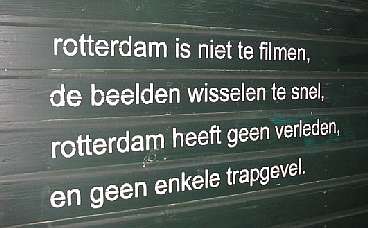
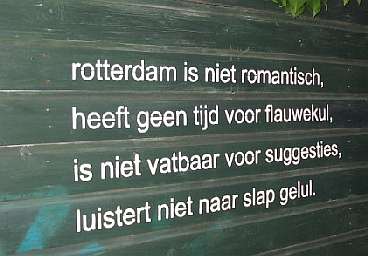
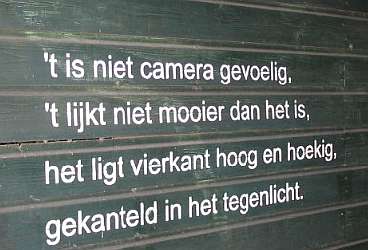
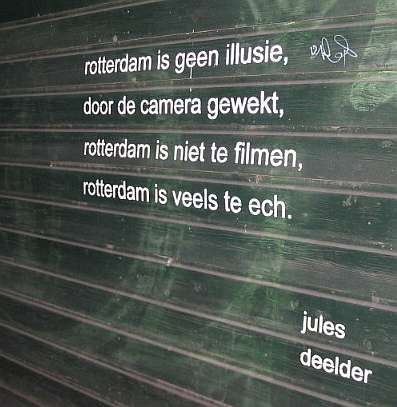
Gisteren een gedicht van Jules Deelder, vandaag opnieuw maar dit keer op een schutting in de Proveniersstraat in Rotterdam.
Het gedicht Rotown Magic wijkt op een paar punten af van de tekst op de schutting. Ik weet niet of dit door de, ongetwijfeld Rotterdamse, schilder van het gedicht is gedaan of dat er een andere reden voor is. Hoe dan ook, de tekst op de schutting is Rotterdamser dan de tekst van het originele gedicht (zoek de verschillen).
.
Rotown magic
Rotterdam is niet te filmen
De beelden wisselen te snel
Rotterdam heeft geen verleden
en geen enkele trapgevèl
.
Rotterdam is niet romantisch
heeft geen tijd voor flauwekul
is niet vatbaar voor suggesties
luistert niet naar slap gelul
.
’t Is niet camera-gevoelig
lijkt niet mooier dan het is
Het ligt vierkant hoog en hoekig
gekanteld in het tegenlicht
.
Rotterdam is geen illusie
door de camera gewekt
Rotterdam is niet te filmen
Rotterdam is vééls te ècht
.
Uit: Vrijwel alle gedichten (2004)
Met dank aan gedichten.nl



 ZICHTBAAR ALLEEN