Site-archief
Diane di Prima
Beatdichter
.
Ergens in het afgelopen jaar (het zal juni geweest zijn) las ik in een rubriek achterop de Volkskrant (Dagboek) een stuk dat uit het dagboek van Dick Hillenius (1927-1987) bioloog en schrijver. Hij schreef in zijn dagboek over taalmuziek. “Taalmuziek heeft al gauw de betekenis van flauwekul. Maar zang en poëzie ontstonden misschien wel uit één bron, lang samen gebleven en door de drang van tijd uit elkaar gedreven.”
Dan gaat hij verder over een avond waarop Diane di Prima (1934 – 2020) Amerikaanse dichter, kunstenaar, prozaschrijver en docent, bekend om haar betrokkenheid bij de Beat-beweging, met een mooie dwingende stem vol stuwing en meeslepend haar poëzie voordraagt. Zoals je begrijpt maakte het me toen al nieuwsgierig maar het bericht was wat op de achtergrond geraakt. Tot ik het nu weer tegenkwam.
Ze ging naar de academisch zeer prestigieuze Hunter College High School, waar ze deel uitmaakte van een kleine vriendengroep, waaronder klasgenote Audre Lorde (schrijfster, professor , filosofe , intersectionele feministe , dichter en burgerrechtenactiviste), die een soort ‘Dode Dichtersgenootschap’ oprichtte en zichzelf ‘de Branded’ noemde. Ze spijbelden om door de stad te zwerven, rond te hangen in boekwinkels, hun eigen gedichten te delen en seances te houden voor dode dichters. Ze bracht de late jaren vijftig en vroege jaren zestig door in Manhattan , waar ze deelnam aan de opkomende Beatbeweging. Ze was redacteur van de krant The Floating Bear en was medeoprichter van het New York Poets Theatre en oprichter van de Poets Press.
Van 1974 tot 1997 gaf di Prima les in poëzie aan de Jack Kerouac School of Disembodied Poetics van het Naropa Institute in Boulder , Colorado, waar zij het programma deelde met mede-Beats Allen Ginsberg en Anne Waldman (medeoprichters van het programma), William Burroughs , Gregory Corso en anderen. Van 1980 tot 1987 doceerde di Prima hermetische en esoterische tradities in de poëzie, in een kortstondig maar belangrijk masterprogramma in poëzie aan het New College of California, dat ze samen met de dichters Robert Duncan en David Meltzer had opgezet.
In 1979 verscheen bij In de Knipscheer haar bundel ‘Revolutionaire brieven’ met gedichten in een vertaling van Simon Vinkenoog. Haar meest vermaarde gedicht ‘April Fool Birthday Poem for Grandpa’ gaat over haar anarchistische grootvader. Di Prima heeft altijd benadrukt hoe belangrijk geschiedenis voor haar is. Dat komt in dit gedicht goed tot uiting.
.
April Fool Birthday Poem for Grandpa
.
Today is your
birthday and I have tried
writing these things before,
but now
in the gathering madness, I want to
thank you
for telling me what to expect
for pulling
no punches, back there in that scrubbed Bronx parlor
thank you
for honestly weeping in time to
innumerable heartbreaking
italian operas for
pulling my hair when I
pulled the leaves off the trees so I’d
know how it feels, we are
involved in it now, revolution, up to our
knees and the tide is rising, I embrace
strangers on the street, filled with their love and
mine, the love you told us had to come or we
die, told them all in that Bronx park, me listening in
spring Bronx dusk, breathing stars, so glorious
to me your white hair, your height your fierce
blue eyes, rare among italians, I stood
a ways off, looking up at you, my grandpa
people listened to, I stand
a ways off listening as I pour out soup
young men with light in their faces
at my table, talking love, talking revolution
which is love, spelled backwards, how
you would love us all, would thunder your anarchist wisdom
at us, would thunder Dante, and Giordano Bruno, orderly men
bent to your ends, well I want you to know
we do it for you, and your ilk, for Carlo Tresca,
for Sacco and Vanzetti, without knowing
it, or thinking about it, as we do it for Aubrey Beardsley
Oscar Wilde (all street lights shall be purple), do it
for Trotsky and Shelley and big/dumb
Kropotkin
Eisenstein’s Strike people, Jean Cocteau’s ennui, we do it for
the stars over the Bronx
that they may look on earth
and not be ashamed.
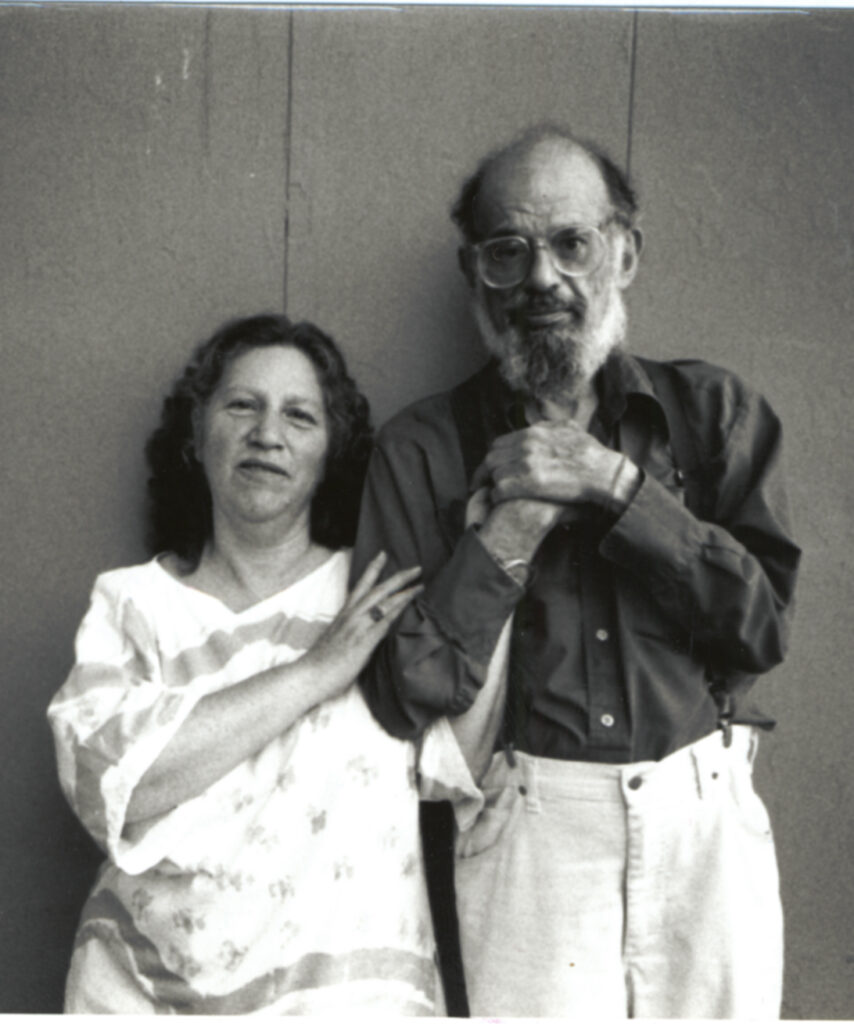
Diane di Prima en Allen Ginsberg
Wat is mogelijk?
Adrienne Rich
.
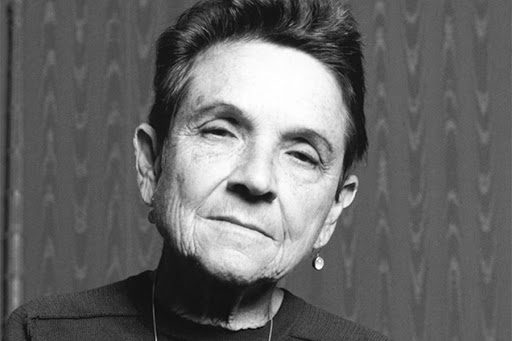
Adrienne (Cecile) Rich (1929 – 2012) was een politiek en sociaal geëngageerde Amerikaanse dichter, docent, essayist, woordvoerder voor de lesbische belangen en feministe. Rich studeerde in 1951 af aan Radcliffe College met een Bachelor of Arts-graad. Op de universiteit las ze moderne Britse en Amerikaanse dichters zoals Wallace Stevens, Robert Frost en W. H. Auden. Haar debuut als dichter met de bundel, ‘A Change of World’, gepubliceerd in hetzelfde jaar dat ze afstudeerde, toont de invloed van deze dichters. Haar carrière als schrijver werd gelanceerd toen ze in 1951, op 22-jarige leeftijd, door W. H. Auden werd gekozen voor de Yale Younger Poets Award.
Adrienne Rich werd een van de meest gelezen en invloedrijkste dichters uit de tweede helft van de 20e eeuw. In de vele dichtbundels die ze schreef is een stilistische evolutie merkbaar vanaf formele poëzie naar een meer persoonlijke en krachtige stijl. Tot haar bekendste gedichten behoren. Met ‘Diving into the Wreck’ (1973) won ze de National Book Award. Ze accepteerde deze prijs samen met twee finalisten, Audre Lorde en Alice Walker, in naam van alle vrouwen. Daarnaast werd ze onder meer bekroond met de Bollingen Prize in 2003 en in 2010 ontving zij de ‘Lifetime Recognition Award’ van de Griffin Poetry Prize.
Door de redactiefilosoof van MUGzine Marie-Anne Hermans werd ik gewezen op een bijzonder gedicht van Adrienne Rich getiteld ‘What is possible’. Wil je het gedicht luisteren? Ga dan naar https://comraderadmila.com/tag/adrienne-rich/ of lees het hieronder.
.
What is possible
.
A clear night if the mind were clear
.
If the mind were simple, if the mind were bare
of all but the most classic necessities:
wooden spoon knife mirror
cup lamp chisel
a comb passing through hair beside a window
a sheet
thrown back by the sleeper
.
A clear night in which two planets
seem to clasp each other in which the earthly grasses
shift like silk in starlight
If the mind were clear
and if the mind were simple you could take this mind
this particular state and say
This is how I would live if I could choose:
that is what is possible
.
A clear night. But the mind
of the woman imagining all this the mind
that allows all this to be possible
is not clear as the night
is never simple cannot clasp
its truths as the transiting planets clasp each other
does not so easily
work free from remorse
does not so easily
manage the miracle
for which mind is famous
or used to be famous
does not at will become abstract and pure
.
this woman’s mind
.
does not even will that miracle
having a different mission
in the universe
.
If the mind were simple if the mind were bare
it might resemble a room a swept interior
but how could this now be possible
given the voices of the ghost-towns
their tiny and vast configurations
needing to be deciphered
the oracular night
with its densely working sounds
.
If it could ever come down to anything like
a comb passing through hair beside a window
.
no more than that
a sheet
thrown back by the sleeper
.
but the mind of the woman thinking this is wrapped in battle
is on another mission
a stalk of grass dried feathery weed rooted in snow
in frozen air stirring a fierce wand graphing
.
Her finger also tracing
pages of a book
knowing better than the poem she reads
knowing through the poem
through ice-feathered panes
the winter
flexing its talons
the hawk-wind
poised to kill
.




 ZICHTBAAR ALLEEN