Site-archief
Gedichten op vreemde plekken
Op een muur van 450 vierkante meter
.
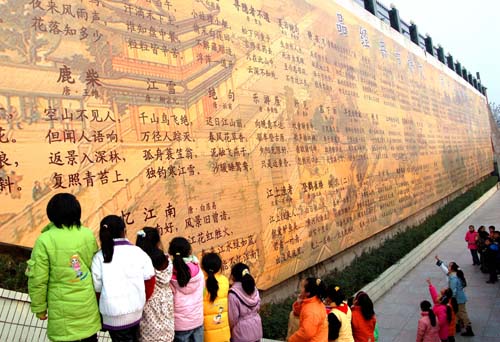
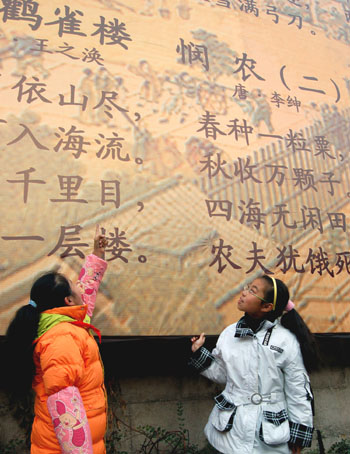
Op een 450 vierkante meter grote muur op de Yunyang Normal University Attached Elementary School campus in het Chinese Chongqing staan 72 klassieke Chinese gedichten geschilderd. Deze muur is opgericht om de studenten te deze traditionele kunstvorm aan te leren.

Voordragen met huisarrest
Liu Xia en Liu Xiaobo
.
Liu Xia is een Chinees dichter, schilderes en fotografe uit Beijing en de vrouw van Nobelprijswinnaar voor de Vrede (2010) Liu Xiaobo. Liu Xiaobo was de president van het onafhankelijk Chinese PEN centrum. International PEN (ook geschreven als P.E.N.) is een internationale organisatie van schrijvers, die zich onder andere inzet voor de vrijheid van meningsuiting en voor schrijvers die om hun meningen worden onderdrukt. Verder heeft de organisatie ten doel vriendschap en samenwerking tussen schrijvers overal ter wereld te bevorderen en de rol van literatuur bij de ontwikkeling van goede wederzijdse verstandhoudingen en cultuur in de wereld onder de aandacht te brengen. De organisatie heeft op dit moment (2005) 141 centra in 99 landen en is georganiseerd naar taalgebied.
Van 1996 tot 1998 zat Liu Xiaobo in een Chinees werkkamp en in die periode schreef hij het volgende gedicht voor zijn vrouw.
.
Voor Xia
De hemel is te weids en vaal
om met mijn zielsogen te doorgronden
Geef me één druppel regen
die de betonnen vloer laat glanzen
geef me één straal licht
die laat zien wat de bliksem wil
Zeg me één woord
en je opent deze deur
waardoor de nacht naar huis kan gaan.
.
Nadat Liu Xiaobo 11 jaar gevangenisstraf had gekregen als mensenrechtenactivist omdat hij had meegeschreven aan Charter 08 (in 2008) waarin de ondertekenaars een aantal eisen neerlegde met betrekking tot verschillende mensenrechten in China. Liu Xia wordt wel gezien als de spreekbuis van Liu Xiaobo en kreeg daarom in oktober 2010 huisarrest opgelegd door de Chinese regering.
In 2013 werd een video het land uit gesmokkeld en afgeleverd bij PEN waarop Liu Xia poëzie van haar hand voordraagt.
.
Met dank aan Wikipedia, Amnesty.nl, vertaling gedicht Liu Xiaobo: Daan Bronkhorst.
Mulan
Films gebaseerd op poëzie Deel 3: Mulan
.
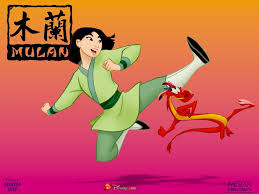
Elke Walt Disneyliefhebber kent wel de Disney klassieker Mulan. Mulan is een Amerikaanse animatiefilm uit 1998 en de 36e grote animatiefilm van Disney. Deze film is losjes gebaseerd op de Chinese legende van Hua Mulan. Een belangrijk onderdeel van de uitgave van de film was de distributie in China. Disney hoopte met Mulan net zo’n grote hit te scoren als met De Leeuwenkoning, die in China een van de meest succesvolle westerse films was. Aanvankelijk werd de film geweigerd daar de Chinese overheid slechts een beperkt aantal westerse films per jaar toestond, maar een jaar na uitgave werd de film alsnog in China vertoond.
Hua Mulan was een heroische vrouw die het leger in ging om China te beschermen tegen de Xiong nu. Beide personen worden beschreven in een ballade.
In Mulan ci wordt het leven en de heldendaden van Hua Mulan beschreven. Deze Chinese poëzie wordt op Chinese scholen en in het voortgezet onderwijs in China en Singapore onderwezen.
.
Hieronder de Engelse vertaling en deel 1 en 2 in het Chinees.
Ode of Mulan
Anonymous (c.5 A.D.)
Tsiek tsiek and again tsiek tsiek,
Mu-lan weaves, facing the door.
You don't hear the shuttle's sound,
You only hear Daughter's sighs.
They ask Daughter who's in her heart,
They ask Daughter who's on her mind.
"No one is on Daughter's heart,
No one is on Daughter's mind.
Last night I saw the draft posters,
The Khan is calling many troops,
The army list is in twelve scrolls,
On every scroll there's Father's name.
Father has no grown-up son,
Mu-lan has no elder brother.
I want to buy a saddle and horse,
And serve in the army in Father's place."

In the East Market she buys a spirited horse,
In the West Market she buys a saddle,
In the South Market she buys a bridle,
In the North Market she buys a long whip.
At dawn she takes leave of Father and Mother,
In the evening camps on the Yellow River's bank.
She doesn't hear the sound of Father and Mother calling,
She only hears the Yellow River's flowing water cry tsien tsien.

At dawn she takes leave of the Yellow River,
In the evening she arrives at Black Mountain.
She doesn't hear the sound of Father and Mother calling,
She only hears Mount Yen's nomad horses cry tsiu tsiu.
She goes ten thousand miles on the business of war,
She crosses passes and mountains like flying.
Northern gusts carry the rattle of army pots,
Chilly light shines on iron armor.
Generals die in a hundred battles,
Stout soldiers return after ten years.

On her return she sees the Son of Heaven,
The Son of Heaven sits in the Splendid Hall.
He gives out promotions in twelve ranks
And prizes of a hundred thousand and more.
The Khan asks her what she desires.
"Mu-lan has no use for a minister's post.
I wish to ride a swift mount
To take me back to my home."

When Father and Mother hear Daughter is coming
They go outside the wall to meet her, leaning on each other.
When Elder Sister hears Younger Sister is coming
She fixes her rouge, facing the door.
When Little Brother hears Elder Sister is coming
He whets the knife, quick quick, for pig and sheep.
"I open the door to my east chamber,
I sit on my couch in the west room,
I take off my wartime gown
And put on my old-time clothes."
Facing the window she fixes her cloudlike hair,
Hanging up a mirror she dabs on yellow flower powder
She goes out the door and sees her comrades.
Her comrades are all amazed and perplexed.
Traveling together for twelve years
They didn't know Mu-lan was a girl.
"The he-hare's feet go hop and skip,
The she-hare's eyes are muddled and fuddled.
Two hares running side by side close to the ground,
How can they tell if I am he or she?"
Uit: The Flowering Plum and the Palace Lady: Interpretations of Chinese Poetry
Door Han H. Frankel, Yale University Press, 1976.
.