Site-archief
Twee uur, bier
Poëzie en film
.
De film Barfly uit 1987 van Barbet Schroeder is een semi-autobiografische film naar het leven van Charles Bukowski. In deze film worden de hoofdrollen vertolkt door Mickey Rourke (die het alter ego van Bukowski speelt Henry Chinaski) en Faye Dunaway (die Wanda Wilcox speelt). Charles Bukowski komt ook heel even kort voor in de film als cameo in een stukje zonder tekst.
Een korte inhoud van de film: Henry Chinaski is dichter en alcoholist, en spendeert zijn dagen in de kroeg. Op een dag ontmoet hij Wanda. Zij is ook alcoholist, en Henry wordt verliefd op haar. Even lijkt het erop dat Henry’s gedichten succesvol worden, maar zijn beroemdheid is van korte duur. Het wordt de twee duidelijk dat ze eigenlijk maar één doel in hun leven hebben, en dat is drinken en de buitenwereld laten voor wat die is.
In de film komen twee (delen) van gedichten voor van Charles Bukowski: ‘2 P.M. Beer’ en ‘Old man, dead in a room’. De laatste komt uit een bijzonderecollectie gedichten met de titel ‘It catches my heart in its hands’ (Loujon Press, 1963). De naam van de collectie gedichten is een regel uit het werk van Robinson Jeffers, een vroege inspiratiebron van Bukowski.
.
“2 p.m. beer”
.
nothing matters
but flopping on a mattress
with cheap dreams and a beer
as the leaves die and the horses die
and the landladies stare in the halls;
brisk the music of pulled shades,
a last man’s cave
in an eternity of swarm
and explosion;
nothing but the dripping sink,
the empty bottle,
euphoria,
youth fenced in,
stabbed and shaven,
taught words
propped up
to die.”
.
“Old man, dead in a room”
.
this thing upon me is not death
but it’s as real
and as landlords full of maggots
pound for rent
I eat walnuts in the sheath
of my privacy
and listen for more important
drummers;
it’s as real, it’s as real
as the broken-boned sparrow
cat-mouthed, uttering
more than mere
miserable argument;
between my toes I stare
at clouds, at seas of gaunt
sepulcher. . .
and scratch my back
and form a vowel
as all my lovely women
(wives and lovers)
break like engines
into steam of sorrow
to be blown into eclipse;
bone is bone
but this thing upon me
as I tear the window shades
and walk caged rugs,
this thing upon me
like a flower and a feast,
believe me
is not death and is not
glory
and like Quixote’s windmills
makes a foe
turned by the heavens
against one man;
…this thing upon me,
great god,
this thing upon me
crawling like snake,
terrifying my love of commonness,
some call Art
some call Poetry;
it’s not death
but dying will solve its power
and as my grey hands
drop a last desperate pen
in some cheap room
they will find me there
and never know
my name
my meaning
nor the treasure
of my escape.
.

The Notebook
Poëzie en Film
.
In de film ‘The Notebook’ van Nick Cassavetes uit 2004 naar een boek van Nicholas Sparks. In de hoofdrollen zijn Ryan Gosling en Rachel McAdams te zien naast Gena Rowlands en James Garner. Leuk weetje is dat de twee hoofdrolspelers in 2005 bij de MTV movie awards de prijs wonnen voor beste kus.
Het verhaal van de film gaat over verloren liefdes en in de film zijn twee gedichten van Walt Whitman verwerkt; ‘Spontaneous me’ en ‘So long’ .
.
So long!
To conclude, I announce what comes after me.
I remember I said before my leaves sprang at all,
I would raise my voice jocund and strong with reference to consummations.
When America does what was promis’d,
When through these States walk a hundred millions of superb persons,
When the rest part away for superb persons and contribute to them,
When breeds of the most perfect mothers denote America,
Then to me and mine our due fruition.
I have press’d through in my own right,
I have sung the body and the soul, war and peace have I sung, and
the songs of life and death,
And the songs of birth, and shown that there are many births.
I have offer’d my style to every one, I have journey’d with confident step;
While my pleasure is yet at the full I whisper So long!
And take the young woman’s hand and the young man’s hand for the last time.
I announce natural persons to arise,
I announce justice triumphant,
I announce uncompromising liberty and equality,
I announce the justification of candor and the justification of pride.
I announce that the identity of these States is a single identity only,
I announce the Union more and more compact, indissoluble,
I announce splendors and majesties to make all the previous politics
of the earth insignificant.
I announce adhesiveness, I say it shall be limitless, unloosen’d,
I say you shall yet find the friend you were looking for.
I announce a man or woman coming, perhaps you are the one, (So long!)
I announce the great individual, fluid as Nature, chaste,
affectionate, compassionate, fully arm’d.
I announce a life that shall be copious, vehement, spiritual, bold,
I announce an end that shall lightly and joyfully meet its translation.
I announce myriads of youths, beautiful, gigantic, sweet-blooded,
I announce a race of splendid and savage old men.
O thicker and faster–(So long!)
O crowding too close upon me,
I foresee too much, it means more than I thought,
It appears to me I am dying.
Hasten throat and sound your last,
Salute me–salute the days once more. Peal the old cry once more.
Screaming electric, the atmosphere using,
At random glancing, each as I notice absorbing,
Swiftly on, but a little while alighting,
Curious envelop’d messages delivering,
Sparkles hot, seed ethereal down in the dirt dropping,
Myself unknowing, my commission obeying, to question it never daring,
To ages and ages yet the growth of the seed leaving,
To troops out of the war arising, they the tasks I have set
promulging,
To women certain whispers of myself bequeathing, their affection
me more clearly explaining,
To young men my problems offering–no dallier I–I the muscle of
their brains trying,
So I pass, a little time vocal, visible, contrary,
Afterward a melodious echo, passionately bent for, (death making
me really undying,)
The best of me then when no longer visible, for toward that I have
been incessantly preparing.
What is there more, that I lag and pause and crouch extended with
unshut mouth?
Is there a single final farewell?
My songs cease, I abandon them,
From behind the screen where I hid I advance personally solely to you.
Camerado, this is no book,
Who touches this touches a man,
(Is it night? are we here together alone?)
It is I you hold and who holds you,
I spring from the pages into your arms–decease calls me forth.
O how your fingers drowse me,
Your breath falls around me like dew, your pulse lulls the tympans
of my ears,
I feel immerged from head to foot,
Delicious, enough.
Enough O deed impromptu and secret,
Enough O gliding present–enough O summ’d-up past.
Dear friend whoever you are take this kiss,
I give it especially to you, do not forget me,
I feel like one who has done work for the day to retire awhile,
I receive now again of my many translations, from my avataras
ascending, while others doubtless await me,
An unknown sphere more real than I dream’d, more direct, darts
awakening rays about me, So long!
Remember my words, I may again return,
I love you, I depart from materials,
I am as one disembodied, triumphant, dead.
.

Holy Smoke
Poëzie in de film
.
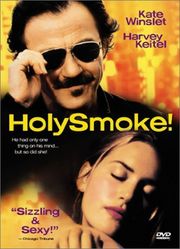
In de film Holy Smoke uit 1999 van Jane Campion met in de hoofdrollen Kate Winslet en Harvey Keitel komt het gedicht ‘Ignorance’ voor van Philip Larkin (1922-1985). De film Holy Smoke gaat over Ruth, die na een reis naar India in de ban komt van Indiase goeroe’s als Bhagwan Shri Shiv, Bhagwan Shri Kishan en Devi Maa Lakshmi. Haar moeder bezoekt haar in India en lokt haar naar huis (VS) met het bericht dat haar vader op sterven ligt. Eeenmaal in de VS wordt ze vastgehouden in een huisje in de woestijn samen met de Cult exorcist P.J. Waters. Philip Arthur Larkin was schrijver, dichter en jazz criticus (en een tijdje werkzaam als bibliothecaris). Uit zijn bundel ‘The Whitsun Weddings’ (1964) het gedicht ‘Ignorance’. Wil je het gedicht beluisteren, voorgelezen door Philip Larkin? Ga dan naar: http://www.youtube.com/watch?v=7469bvS5mRk
Ignorance
.
Strange to know nothing, never to be sure
Of what is true or right or real,
But forced to qualify or so I feel,
Or Well, it does seem so:
Someone must know.
.
Strange to be ignorant of the way things work:
Their skill at finding what they need,
Their sense of shape, and punctual spread of seed,
And willingness to change;
Yes, it is strange,
.
Even to wear such knowledge - for our flesh
Surrounds us with its own decisions -
And yet spend all our life on imprecisions,
That when we start to die
Have no idea why.
.
Into the wild
Poëzie en film
.
Into the wild, de film van Sean Penn uit 2007 is behalve een bijzondere mooie film om nog een reden een aanrader namelijk om de filmmuziek van Eddie Vedder. Heel anders dan de muziek die hij maakt met Pearl Jam maar nog steeds prachtig.
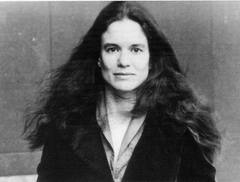
In deze, op een waar gebeurde verhaal gebaseerde, film met Emile Hirsch in de hoofdrol komt het gedicht ‘I go back to may 1937’ uit The Gold Cell (1987) van Sharon Olds (1942) voor.
.
I go back to may 1937
.
Uit: Selected poems 1980-2002

Laatste zinnen Blade Runner
Rutger Hauer
.
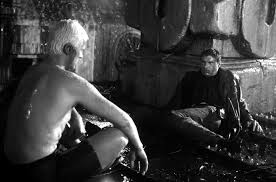
Vandaag was ik in Amsterdam waar tijdens de Biebplaza, Gene Tan (directeur bibliotheek Singapore) zijn liefde voor de film deelde met het publeik. Volgens hem was een van de mooiste scenes uit een film ooit de laatste (sterf)scene uit Blade Runner.
de laatste zinnen hebben een hoog poëtisch karakter en de allerlaatste woorden zijn het motto (één van de twee motto’s) van mijn eerste dichtbundel die ik samen met Ruben Philipsen maakte ‘Zichtbaar alleen’.
I’ve seen things you people wouldn’t believe. Attack ships on fire off the shoulder of Orion. I watched c-beams glitter in the dark near the Tannhäuser Gate. All those moments will be lost in time, like tears in rain. Time to die.
.
.
Dead poet society
De ultieme poëzie film
.
Wat mij betreft is er geen enkele film die de poëzie meer eer aandoet dan Dead poet society van peter Weir uit 1989. Deze meermalen bekroonde film (waaronder een Oscar voor beste screenplay) zit vol prachtige gedichten. Het verhaal van een Engels professor die zijn studenten inspireert en ze de liefde voor de poëzie bijbrengt is van alle tijden en eigenlijk zou elke talendocent een voorbeeld moeten nemen aan deze John Keating.
.
De gedichten die in de film voorkomen zijn:
Walden van Henry David Thoreau (1917 – 1862)
The road not taken van Robert Frost (1874 – 1963)
To the Virgins van Robbert Herrick (1591 – 1674)
O Captain! My Captain! van Walt Whitman (1819 – 1892)
Ulysses van Alfred Tennyson (1809 – 1892)
Shall I Compare Thee To A Summersday van William Shakespeare (1564 – 1616)
She walks in beauty van Lord (George Gordon) Byron (1788 – 1824)
scene uit A Midsummer night’s dream door Puck (1595/1596)
.
Hieronder de scene van Puck uit A Midsummer night’s dream.
.
If we shadows have offended,
Think but this, and all is mended,
That you have but slumber’d here
While these visions did appear.
And this weak and idle theme,
No more yielding but a dream,
Gentles, do not reprehend:
if you pardon, we will mend:
And, as I am an honest Puck,
If we have unearned luck
Now to ‘scape the serpent’s tongue,
We will make amends ere long;
Else the Puck a liar call;
So, good night unto you all.
Give me your hands, if we be friends,
And Robin shall restore amends.
.

Allerlei aardige feiten over deze film kun je lezen op: http://www.imdb.com/title/tt0097165/trivia
Nieuwe categorie: Poëzie en film
Een nieuwe lente een nieuw geluid
.
Ooit zag ik een film, een Hollywoodproductie, hoogst waarschijnlijk een romcom, waar tijdens een huwelijksfeest een gedicht werd voorgedragen. Een bijzonder mooi gedicht. Toen ik het zag dacht ik, dat moet ik onthouden. Je raadt het al, ik ben het vergeten. Afgelopen zaterdag bedacht ik me dat in veel films gebruik wordt gemaakt van gedichten en poëzie. Ik plaatste op Facebook een oproepje en heb inmiddels zoveel reacties ontvangen dat ik een nieuwe categorie ga starten: Poëzie en film.
Ik wil hier verder gaan dan alleen gedichten die in films worden voorgedragen, ook gedichten of dichters die een rol spelen in de film, in titels of op een andere manier van invloed zijn op een film zal ik behandelen. En als iemand weet welke film en welk gedicht het was in die ene romcom mag zich melden.
.
Four Weddings and a Funeral (1994)
.
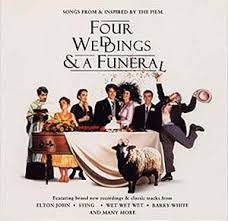
Een van de bekendste scenes in deze film van regisseur Mike Newell is de begrafenis van Gareth waarbij het gedicht Funeral Blues van W.H. Auden wordt voorgedragen. Deze scene vormt een keerpunt in de film. De begrafenis op een druilerige, grijze en regenachtige dag sluit prachtig aan op de woorden van W.H. Auden.
.
Funeral Blues
.
Stop all the clocks, cut off the telephone
Prevent the dog from barking with a juicy bone
Silence the piano’s and with muffled drum
Bring out the coffin, let the mourners come
.
Let aeroplanes circle moaning overhead
Scribbling in the sky the message: he is dead
Put crêpe bows round the white necks of the public doves
Let the traffic policemen wear black cotton gloves
.
He was my North, my South, my East and West
My working week and my sunday rest
My noon, my midnight, my talk, my song
I thought that love would last for ever, I was wrong
.
The stars are not wanted now: put out every one
Pack up the moon and dismantle the sun
Pour away the ocean and sweep up the wood
For nothing now can ever come to any good
.




 ZICHTBAAR ALLEEN