Site-archief
La Belle Dame sans Merci
John Keats
.
In 1819 schreef de Engelse dichter John Keats de ballade ‘La Belle Dame sans Merci’. Hij gebruikte de titel van een veel oudere ballade uit ongeveer 1424 van de Franse dichter Alain Chartier getiteld ‘La Belle Dame sans Mercy’. Hoewel de titels dus vrijwel hetzelfde zijn is de inhoud van de beide gedichten volledig verschillend.
Het gedicht wordt beschouwd als een Engelse klassieker, stereotiep voor andere werken van Keats (1795 – 1821). Het vermijdt de eenvoud van de interpretatie ondanks de eenvoud van de structuur. Hoewel eenvoudig van structuur (slechts twaalf korte stanzas, van slechts vier regels elk, met een simpel ABCB rijmschema) , zit het gedicht toch vol raadsels en is het onderwerp van talrijke interpretaties geweest.
Keats maakt gebruik van een stanza van drie jambische tetrameters met de vierde dimetrische lijnen, waardoor de stanza een zelfstandige eenheid lijkt en waardoor de ballad een doelbewuste en langzame beweging heeft die aangenaam is om naar te luisteren. Keats maakt gebruik van een aantal van de stijlkenmerken van de ballad, zoals de eenvoud van de taal, herhaling en afwezigheid van details. Keats’s ‘zuinige’ manier om een verhaal te vertellen in “La Belle Dame sans Merci” is het tegenovergestelde van zijn overdreven manier waarop hij bijvoorbeeld in ‘The Eve of St. Agnes’ schrijft. Een deel van de fascinatie die door het gedicht wordt uitgeoefend komt voort uit het gebruik van het understatement door Keats.
.
La Belle Dame sans Merci
.
O what can ail thee, knight-at-arms,
Alone and palely loitering?
The sedge has withered from the lake,
And no birds sing.
O what can ail thee, knight-at-arms,
So haggard and so woe-begone?
The squirrel’s granary is full,
And the harvest’s done.
I see a lily on thy brow,
With anguish moist and fever-dew,
And on thy cheeks a fading rose
Fast withereth too.
I met a lady in the meads,
Full beautiful, a fairy’s child;
Her hair was long, her foot was light,
And her eyes were wild.
I made a garland for her head,
And bracelets too, and fragrant zone;
She looked at me as she did love,
And made sweet moan
I set her on my pacing steed,
And nothing else saw all day long,
For sidelong would she bend, and sing
A faery’s song.
She found me roots of relish sweet,
And honey wild, and manna-dew,
And sure in language strange she said—
‘I love thee true’.
She took me to her Elfin grot,
And there she wept and sighed full sore,
And there I shut her wild, wild eyes
With kisses four.
And there she lullèd me asleep,
And there I dreamed—Ah! woe betide!—
The latest dream I ever dreamt
On the cold hill side.
I saw pale kings and princes too,
Pale warriors, death-pale were they all;
They cried—‘La Belle Dame sans Merci
Hath thee in thrall!’
I saw their starved lips in the gloam,
With horrid warning gapèd wide,
And I awoke and found me here,
On the cold hill’s side.
And this is why I sojourn here,
Alone and palely loitering,
Though the sedge is withered from the lake,
And no birds sing.
.

John William Waterhouse (1893)
America, A Prophecy
Waar Zichtbaar alleen, William Blake en Bladerunner samen komen
.
In 2007 kwam mijn eerste dichtbundel uit ‘Zichtbaar alleen’. Deze bundel, die ik samen met fotograaf/kunstenaar Ruben Philipsen heb gemaakt, bevat twee ‘motto’s waaronder een uitspraak van Rurtger Hauer uit ‘Bladerunner (1982) die als volgt gaat: “All those moments will be lost in time, like tears in rain”. Nu binnenkort het vervolg op Bladerunner in de bioscoop verschijnt moet ik hier nog wel eens aan denken.
Nu las ik op een website over poëzie en films dat in het origineel van Bladerunner uit 1982 ook een gedicht is gebruikt van William Blake. Het blijkt hier te gaan om (een deel uit) het gedicht ‘America, A Prophecy’ uit 1793. William Blake die tijdens zijn leven een arm en berooid bestaan leefde werkte als dichter maar vooral als illustrator. ‘America, A Prophecy’ heeft hij thuis geschreven, geïllustreerd en uitgegeven. Van het origineel zijn nog 14 stuks bewaard gebleven.
Het gedicht gaat in grote lijnen over Europa en Amerika waarbij de focus ligt op Amerika als het beloofde, het profetische land. Het is een verhalend gedicht en wordt gezien als een profetie, een voorspellend verhaal over gebeurtenissen in de toekomst. Blake was heel hoopvol over de ontwikkelingen tijdens de Amerikaanse revolutie maar hij was heel teleurgesteld in het feit dat dit niet leidde tot het afschaffen van de slavernij.
Uit het gedicht een tweetal strofes die in het origineel van Bladerunner voorkomen. Wil je de hele tekst lezen kijk dan hier http://www.bartleby.com/235/257.html
.
America, A Prophecy
.
Fiery the Angels rose, & as they rose deep thunder roll’d
Around their shores: indignant burning with the fires of Orc
And Bostons Angel cried aloud as they flew thro’ the dark night.
He cried: Why trembles honesty and like a murderer,
Why seeks he refuge from the frowns of his immortal station!
Must the generous tremble & leave his joy, to the idle: to the pestilence!
That mock him? who commanded this? what God? what Angel!
.
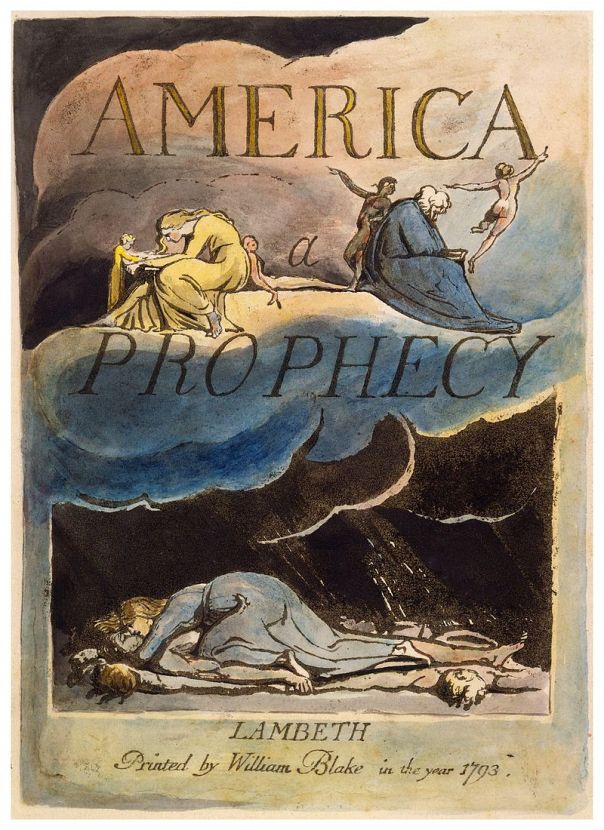

Afbeeldingen uit de collectie van The Morgan Library
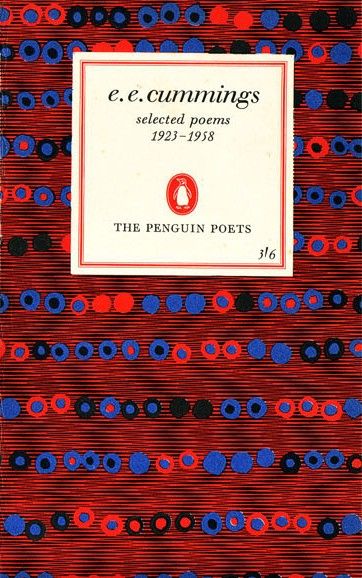
Selected poems 1923 – 1958
e.e. cummings
.
Zoals de regelmatige lezer van dit blog weet, ben ik een groot fan van de poëzie van E.E. Cummings. Ik weet nog hoe blij ik was toen ik de bundel ‘100 selected poems ‘ van hem kon kopen in Londen in een tweedehands boekenwinkeltje. Nu blijkt er ook al (blijkbaar) lange tijd een andere bundel van hem in mijn boekenkast te staan waarvan ik het bestaan vergeten was namelijk ‘Selected poems 1923 – 1958’ in een Penguin pocket reeks namelijk ‘The Penguin Poets’ uit 1960.
De selectie is door Cummings zelf gedaan uit elf gedichtenbundels (waarvan 10 uit een verzamelbundel ‘Poems 1923 – 1954′ en een elfde bundel getiteld ’95 Poems’ uit 1958.
Uit deze kleine maar o zo fijne bundel koos ik voor het gedicht zonder titel met als openingszin ‘love is more thicker than forget’.
.
love is more thicker than forget
more thinner than recall
more seldom than a wave is wet
more frequent than to fail
.
it is most mad and moonly
and less it shall unbe
than all the sea which only
is deeper than the sea
.
love is less always than to win
less never than alive
less bigger than the least begin
less littler than forgive
.
it is most sane and sunly
and more it cannot die
than all the sky which only
is higher than the sky
.
Singing poetry
Vachel Lindsay
.
Het leuke van dit blog dagelijks schrijven en delen is dat ik steeds vaker tips en reacties krijg op de stukken die ik hier plaats. Waarvoor dank! Naar aanleiding van het stuk over de Bertsolari van afgelopen donderdag reageerde Akim AJ Willems. Hij schreef dat Vachel Lindsay al enkele decennia eerder een slam-poet-avant-la-lettre was. Dat hoef je maar één keer tegen me te zeggen natuurlijk want dan ben ik meteen nieuwsgierig naar wie die Vachel Lindsay dan wel was.
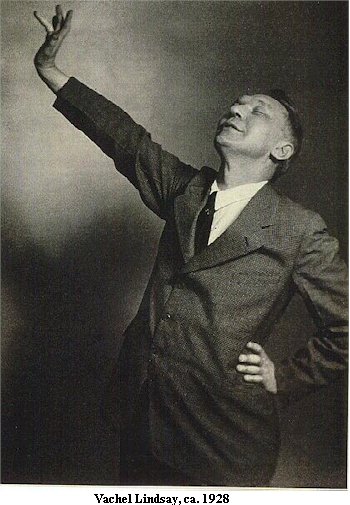
Nicholas Vachel Lindsay (1879 – 1931) was een Amerikaans dichter die wel gezien wordt als de oprichter of bedenker van de ‘Singing poetry’ waarbij gedichten worden gezongen of gescandeerd. In die zin kun je hem beschouwen als een voorloper van de slam poëzie en/of spoken word. Hoewel zijn ouders wilde dat hij dokter zou worden dacht Lindsay daar anders over. Hij studeerde Pen & Ink aan de New York School of Art. In New York groeide zijn liefde voor poëzie. Hij probeerde zijn gedichten, die hij zelf stencilde, op straat aan de man te brengen. Daar begon hij ook met een soort ruilhandel: Een gedicht voor een stuk brood.
Tussen 1906 en 1908 reisde hij tussen Florida en Kentucky en van New York tot Ohio en voorzag hij in zijn levensbehoefte door het ruilen van gedichten tegen voedsel en onderdak. In die zin leefde hij als een moderne troubadour. In 1912 reisde hij opnieuw, nu van Illinois tot New Mexico. Tijdens deze reis schreef hij zijn meest bekende werk ‘The Congo’. Toen hij was teruggekeerd werden zijn gedichten voor het eerst gepubliceerd in Poetry magazine en werd hij al snel heel bekend als dichter.
Zijn bekendste gedicht, “The Congo”, illustreert zijn revolutionaire idee over de esthetiek van geluid ter wille van het geluid. Het imiteert het stampen van de trommels in de ritmes en in onomatopoeïsche onzinwoorden. Bij sommige delen van het gedicht gebruikt Lindsay conventionele woorden deze verbeelden het chanten van de inheemse bevolking van Congo, die uitsluitend en alleen op geluid vertrouwen.
In 1931 leefde Lindsay een berooid leven en was hij ziek door het intensieve reizen om geld voor zijn familie te verdienen. In dat jaar pleegde hij zelfmoord door het drinken van een fles Lysol schoonmaakmiddel. Zijn laatste woorden waren: They tried to get me; I got them first!
De volledige tekst van het gedicht ‘The Congo’ kun je hier lezen: http://xroads.virginia.edu/~hyper/lindsay/lindsay.html#congo
Hier hoor je het gedicht zoals ‘gezongen’ door Vachel Lindsay zelf.
.
Sound of silence
Simon & Garfunkel
.
Of je er van houdt of niet, het nummer ‘Sound of Silence’ is niet alleen een heel beroemd en bekend nummer maar het heeft ook een tekst met grote poëtische waarde. Op de website http://straypoetry.com/100-poetic-songs/. staan 100 liedteksten beschreven die volgens de schrijver van deze website Ezra Hilyer ‘poëtisch van aard zijn en uit zijn eigen verzameling komen’. Een mooi subjectief gegeven (want over smaak valt altijd te twisten) maar neem eens een kijkje en je zult zien dat Ezra weet waarover hij praat en schrijft.
The sound of silence dus. In zijn commentaar geeft hij het volle aantal ‘punten’ (10 uit 10) voor dit lied aan het aspect ‘Lyrical poetry’, ongeveer een 6 voor ‘Emotional resonance’en ongeveer een 4 voor ‘Instrumental beauty’. Als je, zoals ik, vooral over geschreven en uitgesproken poëzie schrijft dan zijn de laatste twee voor mij duidelijk van minder belang dan de eerste. Als je daarop 100% scoort moet de tekst dus wel heel poëtisch zijn. En dat is ze dus ook.
The sound of silence werd in september 1965 als single werd uitgegeven door Columbia Records. In 1966 bereikte het de nummer 10 positie in de top 40. Art Garfunkel vatte de betekenis van het nummer ooit samen als “The inability of people to communicate with each other, not particularly internationally but especially emotionally”. Ik zou zeggen, oordeel zelf.
.
Sound of Silence
.
Hello darkness, my old friend
I’ve come to talk with you again
Because a vision softly creeping
Left its seeds while I was sleeping
And the vision that was planted in my brain
Still remains
Within the sound of silence
In restless dreams I walked alone
Narrow streets of cobblestone
‘Neath the halo of a street lamp
I turned my collar to the cold and damp
When my eyes were stabbed by the flash of a neon light
That split the night
And touched the sound of silence
And in the naked light I saw
Ten thousand people, maybe more
People talking without speaking
People hearing without listening
People writing songs that voices never share
And no one dared
Disturb the sound of silence
Fools, said I, you do not know
Silence like a cancer grows
Hear my words that I might teach you
Take my arms that I might reach you
But my words, like silent raindrops fell
And echoed in the wells of silence
And the people bowed and prayed
To the neon god they made
And the sign flashed out its warning
In the words that it was forming
And the sign said, the words of the prophets are written on the subway walls
And tenement halls
And whispered in the sounds of silence
.

Poëzie zeker
Wat is poëzie?
.
Als je al jaren over poëzie schrijft, zelf poëzie schrijft en er dagelijks mee bezig bent dan wordt de vraag nog wel een gesteld wat poëzie nu eigenlijk is. Op die vraag is geen eenduidig antwoord mogelijk blijkt. Definities genoeg maar geen enkele definitie is hetzelfde. Daarom ben ik eens op onderzoek uitgegaan wat er zoal over wordt gedacht en gezegd. Ter lering ende vermaeck zeg maar.
De Amerikaanse dichter Emily Dickinson schreef ooit in een brief: “If I feel physically as if the top of my head were taken off, I know that is poetry.” De Engelse dichter A.E. Housman zei hierover: “I have to keep a close watch over my thoughts when I’m shaving in the morning, for if a line of poetry strayed into my memory, a shiver races down my spine and my skin would bristle so that my razor ceased to act.”
Ik vergelijk dit met een eigen ervaring. Wanneer je gaat slapen en je bent bijna in slaap maar nog niet helemaal en je gedachten vormen zich in zinnen waarvan je weet dat dit een gedicht op gaat leveren. Dan moet je jezelf dwingen op te staan, of een pen en papier pakken en deze zinnen op schrijven. Hieruit komen vaak de mooiste gedichten.
Dichters kunnen soms ook heel dichterlijk zijn in het omschrijven wat nu precies poëzie is. Voorbeelden hiervan zijn: ‘A thought, caught in the act of dawning’, ‘Means of bringing the wind in the grasses into the house’, of ‘Poetry is a pheasant disappearing in the brush’.
Net als andere vormen van literatuur kan poëzie proberen een verhaal te vertellen, een drama uit te voeren, ideeën over te brengen, levendige, unieke beschrijvingen te geven of onze innerlijke spirituele, emotionele of psychologische staat van zijn uit te drukken. Toch vestigt poëzie bijzondere aandacht op de woorden zelf: hun geluiden, texturen, patronen en betekenissen. Het is vooral ook interessant om je te concentreren op de verbale muziek die inherent is aan de taal.
Een ander opmerkelijk feit is dat meer dan negentig procent van de gedichten in een standaard poëziebloemlezing ( of dat nu Nederlandstalig, Engels, Duits, Spaans of wat voor taal dan ook is) in formele gestructureerde, hoogpatroonvormige metrische versen geschreven zijn. Terwijl de productie van actuele poëzie in meer dan negentig procent bestaat uit vrije vormen. Hieruit blijkt dat wat er onder poëzie verstaan wordt in de loop van de jaren, deccenia, eeuwen, verandert.
Een Amerikaans dichter zei ooit dat een gedicht een “tijdsmachine” is die uit woorden is gemaakt, waarmee mensen in het verleden met ons kunnen praten en wij kunnen spreken met mensen in het verleden, het heden en de toekomst.
Voorzichtige conclusie na een kort onderzoekje dat in geen enkel opzicht enige wetenschappelijke waarde heeft: Poëzie is een god met vele gezichten of zoals Allen Ginsberg het zei: “Poetry is the one place where people can speak their original human mind, it is the outlet for people to say in public what is known in private”.
En omdat elke aanleiding genoeg is om een gedicht te plaatsen of te lezen deze keer een gedicht van Toon Tellegen over poëzie uit ‘Gewone gedichten’ uit 1998.
.
Voorwaarden waaraan een..
Voorwaarden waaraan een
gedicht moet voldoen
Het moet pijnlijk zijn:
altijd, hoe dan ook.
Ik moet het er nooit mee eens
zijn.
Met een lantaarn en een vergrootglas moet ik –
op mijn knieen en vervolgens op mijn buik –
de logica zoeken,
die het telkens laat vallen.
Het moet zich verheffen – daar mag geen twijfel over zijn –
het moet zich altijd verheffen uit zijn nederige stoel,
de ramen opendoen
en zingen – luidkeels, schor en onzinnig –
over de liefde en over mij,
de geur van rozen en onsterfelijkheid, bijna geloofwaardig,
om zich heen,
en nog pijnlijker moet het zijn, nog veel pijnlijker.
.
Afbeelding Poëziecafé Bibliotheek Amstelland
Brief
Elisabeth Eybers
.
In het boek ‘Kon uit de dood ik die éne doen keren’ uit 1998, las ik een gedicht van de Zuid Afrikaanse dichter Elisabeth Eybers (1915 – 2005). Ik publiceerde al eerder een gedicht van haar hand ‘Die moeder’ op 8 maart van dit jaar. Ook dit gedicht ‘Brief’, oorspronkelijk verschenen in ‘Versamelde gedichte’ in 1995, is van een schoonheid door de taal van Eybers en het Afrikaans. Voor degene die het Afrikaans wat minder macjtig zijn ook de Engelse vertaling (met dank aan John Irons).
.
Brief
.
Moenie die dood verdink, moenie hom vrees:
sy medelye trek ’n vlammekring
om alles wat ooit skoon of teer mog wees
dat geen bederf nog daar kan binnedring.
.
Maar vrees die lewe met sy donker lis,
sy breeksug en sy onverskilligheid:
jou stil geluk, jou stil vertroue is
vir hom in die verbygaan ’n klein buit
.
om vir die aardigheid en met een hou
half ingedagte neer te kap om jou
te herinner dat jy klein is en hy groot.
.
As daar iets is, volkome en onbesmet,
wat kan gered word sal die dood dit red:
daar is geen deernis soos die van die dood.
.
Letter
.
Do not suspect death, do not show him fear.
his pity draws a ring of fire round all
that might be delicate or lovely here
and holds decay off as a shielding wall.
.
Fear life instead with his dark artifice,
indifference and his destructive quest:
your quiet trust, your quiet happiness
for him in passing are as though in jest
.
at one swift blow to hew down some small prey
half absent-mindedly as if to say
remember you are small and he is great.
.
If anything, unsullied, undepraved,
is savable, then death will see it saved:
and death’s compassion none can emulate.
.
Beroemde gedichten
Top 50 famous poems
.
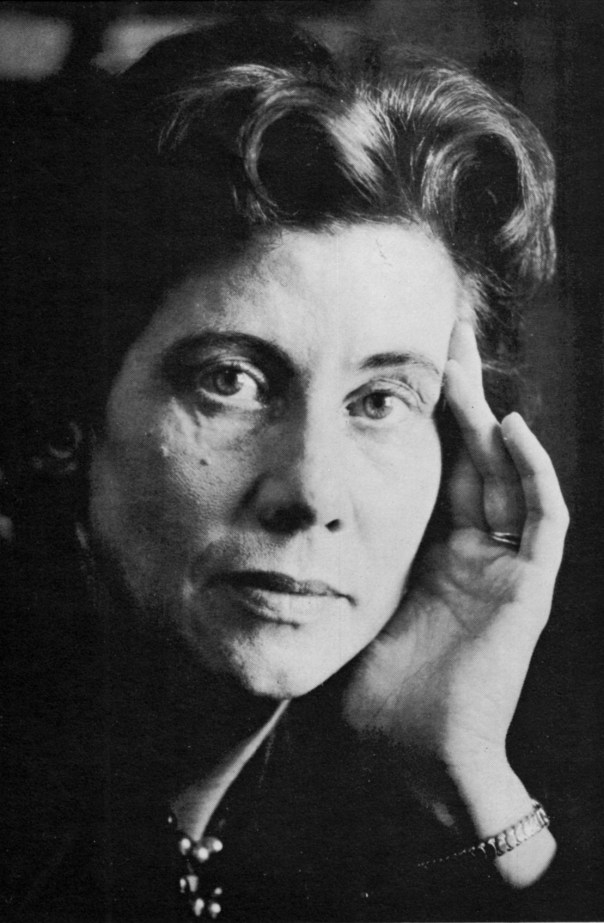
In 2013 schreef ik al eens over de website http://famouspoetsandpoems.com in algemene zin, dat het een bijzonder fijne website is waar veel informatie over dichters en gedichten in het Engelse taalgebied te vinden is. Een onderdeel van deze website is de ‘Top 50 famous poems’. Als we kijken naar de eerste tien gedichten vallen een paar dingen op. Allereerst de nummer 1, Maya Angelou met haar gedicht ‘Phenomenal woman’ dat ik op 28 augustus 2014 plaatste, toen als nummer 1 van de top tien van gedichten van https://www.poemhunter.com/ , ook al zo’n fijne website met Engelstalige poëzie. Niet meteen de eerste dichter waaraan je denkt bij Engelstalige dichters. In de top 10 wel Pablo Neruda, E.E. Cummings, Robert Frost, Emily Dickinson maar bijvoorbeeld niet W.H. Auden, Sylvia Plath of Dylan Thomas. Wel twee keer Shel Silverstein maar William Wordsworth pas op de 16e en W.B. Yeats pas op de 30ste plaats.
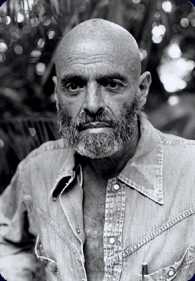
Een bijzonder aardige lijst kortom waarin je naar hartelust gedichten kunt aanklikken. Dat heb ik uiteraard ook gedaan en omdat Shel Silverstein voor mij een redelijke onbekende dichter is heb ik voor zijn hoogstgenoteerde gedicht gekozen )op de 2e plaats) ‘Where the sidewalk ends’. Toen ik wat informatie over Silverstein zocht bleek dat ik hem, via een omweg al heel lang ken namelijk door de teksten die hij schreef voor Dr. Hook.
Sheldon Allan (Shel) Silverstein (1930 – 1999) was een Amerikaanse dichter, singer-songwriter, muzikant, componist, cartoonist, scenarist en auteur van kinderboeken. In de door hem geschreven kinderboeken komt hij zelf voor als Oom Shelby. Zijn boeken zijn vertaald in 20 talen. Hij schreef de teksten en muziek voor het grootste deel van de Dr. Hook-liedjes, waaronder “The Cover Of The Rolling Stone”, “Freakin’ at the Freakers’ Ball” , “Sylvia’s Mother”, “The Things I Didn’t Say”, “Ballsack” en een waarschuwende lied over venerische ziekten “Don’t Give a Dose to the One You Love Most”. Ook het nummer “The ballad of Lucy Jordan”, bekend van Marianne Faithfull, is van zijn hand. De wereldberoemde Johnny Cash-hit “A boy named Sue” is ook van zijn hand. Later schreef hij er een vervolg op: “Father of a boy named Sue”.
.
And before the street begins,
And there the grass grows soft and white,
And there the sun burns crimson bright,
And there the moon-bird rests from his flight
To cool in the peppermint wind.Let us leave this place where the smoke blows black
And the dark street winds and bends.
Past the pits where the asphalt flowers grow
We shall walk with a walk that is measured and slow,
And watch where the chalk-white arrows go
To the place where the sidewalk ends.
Yes we’ll walk with a walk that is measured and slow,
And we’ll go where the chalk-white arrows go,
For the children, they mark, and the children, they know
The place where the sidewalk ends.

Poëziebusdichters 7
Kay Slice
.
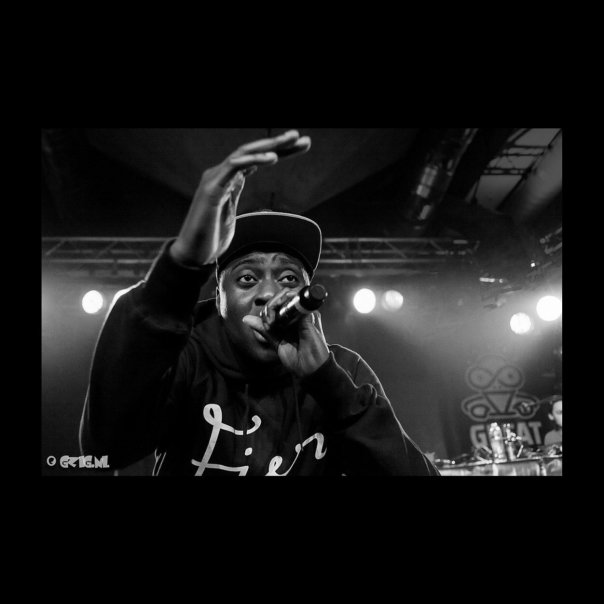
MC en vocalist, wie schrijft die blijft en Kay Slice schrijft en slicet. Snijdend door beats, papier en kenmerkend door zijn strakke en melodieuze flows. Door Hijs beschreven als ‘een geheel eigen en fijn geluid’. Kay is onderdeel van de formatie Brandwerk waarmee hij onder andere heeft opgetreden voor de koning. Zijn beeldende teksten ontpoppen zich ook in poetry. Zo was hij onder meer te zien bij Woorden Worden Zinnen en Spraakuhloos. Alle data en plaatsen van de optredens staan op http://www.poeziebus.nl
.
Slechtste poëzie in het universum
Paula Nancy Millstone Jennings
.
In de, van oorsprong, radio comdey ‘The Hitchhiker’s guide to the Galaxy’ van Douglas Adams, komt de naam voor van Paul Neil Milne Johnstone als zijnde de dichter van de slechtste poëzie in het universum, op de voet gevolgd door de poëzie van de Azgoths of Kria en de Vogons. Johnsone had met Adams op school gezeten en ze hadden zelfs een prijs voor Engels gewonnen met neprecensies over hun eigen gedichten. Toen The Hitchhiker’s Guide to the Galaxy een hit werd (boeken, graphic novels, film, toneelstuk) verving Adams de naam van Johnstone voor die van het fictieve personage Paula Nancy Millstone Jennings. Paul Neil Milne Johnstone werd later redelijk succesvol in de poëziewereld als redacteur en festival organisator.
Een voorbeeld van een gedicht van Paul dat in alle navolgers aan Paula werd toegewezen:
.
The dead swans lay in the stagnant pool.
They lay. They rotted. They turned
Around occasionally.
Bits of flesh dropped off them from
Time to time.
And sank into the pool’s mire.
They also smelt a great deal.
.
Een voorbeeld van hele slechte Vogon poëzie:
.
See, see the underground sky
Marvel at its big black depths.
Tell me, Amy do you
Wonder why the human ignores you?
Why its foobly stare
makes you feel stiff.
I can tell you, it is
Worried by your huftled facial growth
That looks like
A cheese.
What’s more, it knows
Your prissy potting shed
Smells of grapes.
Everything under the big underground sky
Asks why, why do you even bother?
You only charm noses.
.
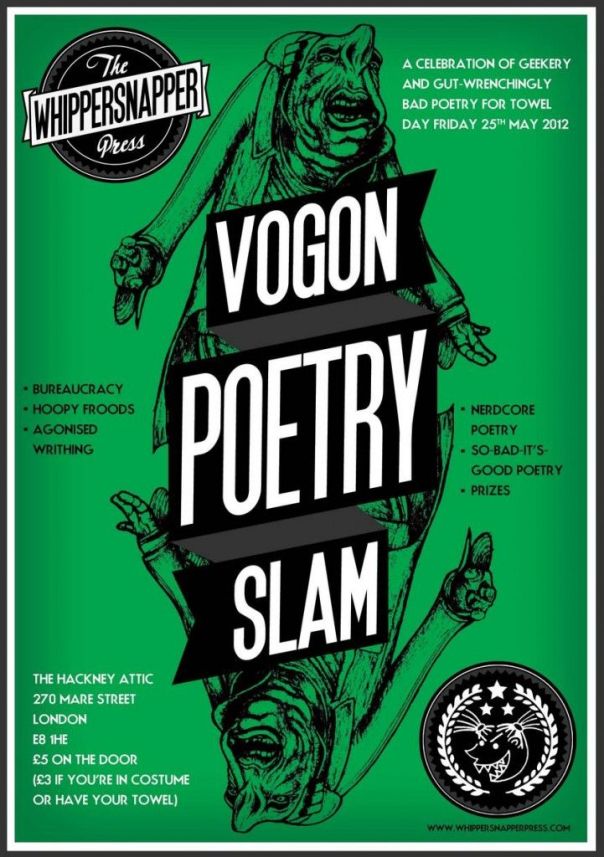
In 2012 werd er in Londen zelfs een Vogon Poetry Slam georganiseerd. Voor de slechtste poëzie of zoals ze daar adverteerden ‘a celebration of Geekery and gut-wrenchingly bad poetry’.
.





 ZICHTBAAR ALLEEN