Site-archief
Spam poetry
Van digitale vuilnisbak tot poëzie
.
Varvara Guljajeva en Mar Canet zijn twee kunstenaars die, om kunst te kunnen maken, nauwkeurig door digitale prullenbakken snuffelen. Miljoenen spam e-mails worden dagelijks over de hele wereld verzonden. De ontvangers worden aangespoord om impotentie pillen te kopen, banen aangeboden of ze worden verteld dat ze miljoenen euro’s hebben gewonnen.
Meestal verdwijnt dit soort e-mails rechtstreeks naar de prullenbak. Maar voor Varvara Guljajeva is deze spam dan nog niet verdwenen. “We wilden de digitale prullenbak recyclen,” zei ze. Het proces waar deze spam doorheen gaat bestaat uit twee delen.
1. genereren van poëzie uit verzamelde SPAM
2. het instellen van een elektronisch breimachine om SPAMpoetry een gebreide vorm te geven
Met betrekking tot het concept, zijn ze geïnteresseerd in het samenbrengen van de digitale cultuur en traditioneel handwerk. Om meer specifiek te zijn, het idee is om te experimenteren met de vorm en betekenis van SPAM. Ze draaien SPAM om in romantische, grappige of zelfs sarcastische poëzie en presenteren die in een ongebruikelijke tastbare vorm zoals breigoed. Om meer specifiek te zijn, noemen ze het eindresultaat disfunctioneel draagbaar, omdat het herinnert aan een trui, maar het niet echt een trui is.
En zo ziet zo’n disfunctioneel draagbare trui er dan uit, met erin gebreid de SPAM poëzie.

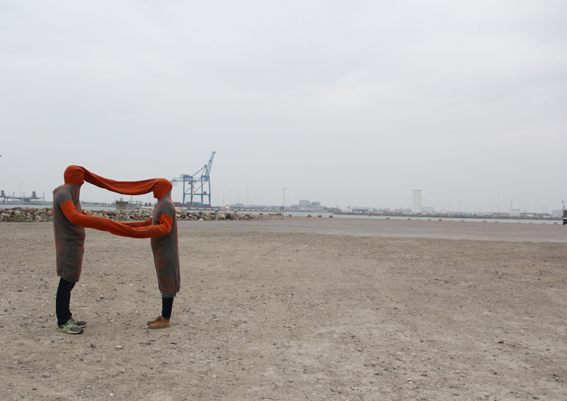
Foto’s : Mar Carnet
Ik schreef al eerder over poëzie op kledingstukken en over SPAM poëzie maar dit is wel een heel bijzondere vorm van gedichten op vreemde plekken gecombineerd met gedichten in vreemde vormen.
Meer lezen over Varvara Guljajeva en Mar Canet en hun bijzondere vormen van poëzie en kunst? Ga dan naar http://www.varvarag.info/spampoetry/
Kobe Bryant
Dear Basketball
.
Kobe Bean Bryant (1978) is één van ’s werelds beste basketballers. Spelend bij de Los Angeles Lakers heeft hij een erelijst om U tegen te zeggen. Twee keer Olympisch kampioen, vijf keer NBA kampioen, twee keer NBA topscorer en een keer meest waardevolle speler van de NBA. Op 37 jarige leeftijd heeft Kobe Bryant in november van dit jaar aangekondigd te gaan stoppen met basketball. Teveel en te langdurige blessures hebben hem tot deze beslissing gebracht.
Onverwacht kondigde hij zijn afscheidsjaar aan met een gedicht in The Players Tribune. Omdat het maar zo zelden voorkomt dat sporters (en zeker sporters van dit kaliber) van zich laten horen middels poëzie, hierbij het gedicht dat hij schreef getiteld ‘Dear Basketball’.
.
Dear Basketball
.
From the moment
I started rolling my dad’s tube socks
And shooting imaginary
Game-winning shots
In the Great Western Forum
I knew one thing was real:
I fell in love with you.
A love so deep I gave you my all —
From my mind & body
To my spirit & soul.
As a six-year-old boy
Deeply in love with you
I never saw the end of the tunnel.
I only saw myself
Running out of one.
And so I ran.
I ran up and down every court
After every loose ball for you.
You asked for my hustle
I gave you my heart
Because it came with so much more.
I played through the sweat and hurt
Not because challenge called me
But because YOU called me.
I did everything for YOU
Because that’s what you do
When someone makes you feel as
Alive as you’ve made me feel.
You gave a six-year-old boy his Laker dream
And I’ll always love you for it.
But I can’t love you obsessively for much longer.
This season is all I have left to give.
My heart can take the pounding
My mind can handle the grind
But my body knows it’s time to say goodbye.
And that’s OK.
I’m ready to let you go.
I want you to know now
So we both can savor every moment we have left together.
The good and the bad.
We have given each other
All that we have.
And we both know, no matter what I do next
I’ll always be that kid
With the rolled up socks
Garbage can in the corner
:05 seconds on the clock
Ball in my hands.
5 … 4 … 3 … 2 … 1
love you always,
Kobe
.


Congregation
Parneshia Jones
.
Over de dichter Parneshia Jones schrijft recensente Ellen Hagan: “ze is een vloeiende, gestage golf , ze is het coole Chicago vermengd met de het late en langzame kruipen van de zondagochtend in New Orleans. Ze is een wereld van een vrouw, een Renaissance moderne priesteres van de planeet aarde”. Parneshia Jones groeide op in de openbare bibliotheek van Evanston, Illinois, en de keuken van haar moeder. Het lezen en schrijven werden voor haar een tweede natuur.
Na haar studie ging ze aan het werk als marketing assistent voor de Northwestern University Press. De laatste twaalf jaar werkte ze voor schrijvers van Pullitzerprijzen, Nobelprijzen en winnaars van de Academy Award. Hierdoor en door het feit dat ze veel ervaring heeft opgedaan met auteurs vanuit de hele wereld op het gebied van poëzie, fictie, theater, voordrachtskunst, literatuur en filosofie, maken dat ze een zeer brede kijk heeft gekregen op het geschreven woord. Dit is ook van grote invloed geweest op haar eigen werk.
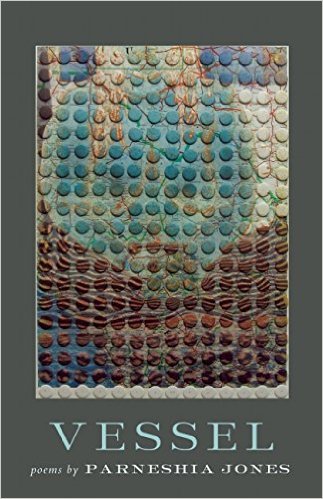
Zo schreef ze veel over zwarte vrouwelijke auteurs, maar met name haar debuutbundel ‘Vessel : poems’ werd zeer goed ontvangen en kreeg meerdere prijzen. Uit deze bundel het gedicht ‘Congregation’.
.
Congregation
.
Weir, Mississippi, 1984
Sara Ross,
Great and Grand-mother of all
rooted things waits on the family porch.
We make our way back to her beginnings.
Six daughters gather space and time
in a small kitchen.
Recipes as old as the cauldron
and aprons wrap around these daughters;
keepers of cast iron and collective
Lard sizzles a sermon from the stove,
frying uncle’s morning catch
into gold-plated, cornmeal catfish.
Biscuits bigger than a grown man’s fist
center the Chantilly laced table of yams,
black eyed peas over rice and pineapple,
pointing upside down cake.
The fields, soaked with breeze and sun,
move across my legs like Sara’s hands.
Chartreuse colored waters, hide and seek
in watermelon patches, dim my ache for Chicago.
Peach and pear ornaments
hang from Sara’s trees. Jelly jars tinted
with homemade whiskey,
guitar stringing uncles who never left
the porch, still dream of being famous
country singers.
Toothpick, tipped hats and sunset
linger as four generations come from
four corners to eat, pray, fuss and laugh
themselves into stories of a kinfolk,
at a country soiree, down in the delta.
.

Smoking poets
Advice to a young poet
.
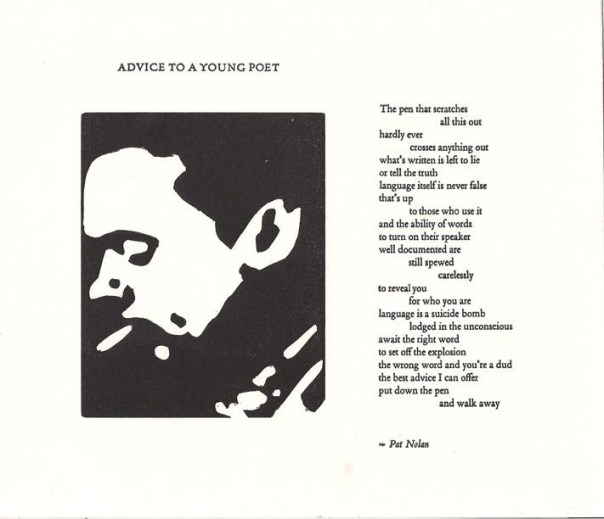
Pat Nolan (1943) is een Canadees dichter die bijna zijn hele leven lang woont in het noorden van California. Hij is behalve dichter ook uitgever, redacteur en vertaler van poëzie. Zijn werk is gepubliceerd in tijdschriften, magazines in de VS, Azië en Europa en is verschenen in verschillende bloemlezingen. In totaal publiceerde Nolan al meer dan een dozijn titels.
Samen met Heith Abbott, Mareen Owen en Michael Sowl is hij de oprichter van de Miner School of Haikai Poets. De Haikai no renga of Renku is een Japanse versvorm die uit de 16e eeuw stamt. Haikai wordt echter ook gebruikt als verzamelnaam voor Japanse versvormen als de Haiku, de Senryu, de Haiga en de Haibun.
Pat Nolan heeft echter ook een bijzonder aardig boekje uitgegeven met poëzie en tekeningen van rokende dichters (smoking poets). Uit de serie Smoking poets hier een aantal voorbeelden van W.H. Auden, André Breton en bij het gedicht van Pat Nolan de rokende dichter Dylan Thomas.
.


Each X Other
Gedichten op kledingstukken
.
Het Parijse modelabel Each X Other heeft in de opzet van haar collectie voor 2015-2016 (FW 15-16) opnieuw gezocht naar het concept ‘Art meets fashion’. Men heeft dit onder andere gedaan met de conceptuele band ‘Liquid Architecture en met de dichter en contemporain kunstenaar Robert Montgomery.
Over Robert Montgomery schreef ik al eerder (op 21 februari 2013) maar toen betrof het billboards en publieke communicatiemogelijkheden die hij gebruikt om zijn poëzie onder de mensen te brengen. Zijn poëzie bespreekt, viert en berispt gelijktijdig het moderne leven en legt op die manier schrijnender dan ooit aan ons uit hoe het zit met het moderne leven.
Uit de FW 15-16 collectie een t-shirt en een trui waarop een gedicht en een fragment van een gedicht van Montgomery is aangebracht. Het gedicht op het t-shirt is te lezen op de laatste foto.
.




Alle kleding in deze collectie is te vinden op:
http://www.each-other.com/download/press/fw15/04_LINESHEET/EachxOther_Linesheet_FW15.pdf
Bij die wilg, van god verlaten
W.H. Auden
.
Bij de kringloopwinkel kocht ik het kleine maar fijne bundeltje van uitgeverij Bert Bakker uit 1995 ‘Vertel me de waarheid over liefde’ met gedichten van W.H. Auden met vertalingen van Willem Wilmink. Op de achterflap van de bundel staat te lezen:
“De poëzie van W.H. Auden hoort tot de mooiste van de twintigste eeuw. In deze bundel zijn een tiental van zijn tijdloze, even schitterende als aangrijpende liefdesgedichten bijeengebracht.”
Uit deze bundel het gedicht ‘Underneath an abject willow’ in het Engels en in de vertaling van Wilmink.
.
Underneath an Abject Willow
.
Underneath an abject willow,
Lover, sulk no more:
Act from thought should quickly follow.
What is thinking for?
Your unique and moping station
Proves you cold;
Stand up and fold
Your map of desolation.
.
Bells that toll across the meadows
From the sombre spire
Toll for these unloving shadows
Love does not require.
All that lives may love; why longer
Bow to loss
With arms across?
Strike and you shall conquer.
.
Geese in flocks above you flying.
Their direction know,
Icy brooks beneath you flowing,
To their ocean go.
Dark and dull is your distraction:
Walk then, come,
No longer numb
Into your satisfaction.
Viewfinder
Behind the Barracks
.
Via via kom je soms van de ene op de andere site en loop je tegen gedichten op vreemde plekken op. Zo ging het ook bij het gedicht ‘Viewfinder’ van Alice Lyons, dat zich naast de Barracks, in Cootehall, County Roscommon (Ierland) bevind op een glazen raam. Via een gedicht op een trap kwam ik op de website http://www.alicelyons.blogspot.ie/.
‘Viewfinder’ maakt deel uit van AFTER, een serie openbare kunstwerken die de ongekende gevolgen van de (in 2008) economische boom van Ierland op het landschap als onderwerp hebben. Deze kunstwerken werden mogelijk gemaakt door TRADE, het international artist in residence programma.
.
Viewfinder
In the shed beside the Barracks
in the shade of it, damp and February cool I feel
I am standing in a camera
The shed walls frame a picture
of the river and across it
sunlit luxury bungalows
all lined up to face The View
Here where a boy squatted
overheard the father’s plot
(This was in “Korea”)
to sell his son downriver
.


Lozenges
Gedichten in vreemde vormen
.
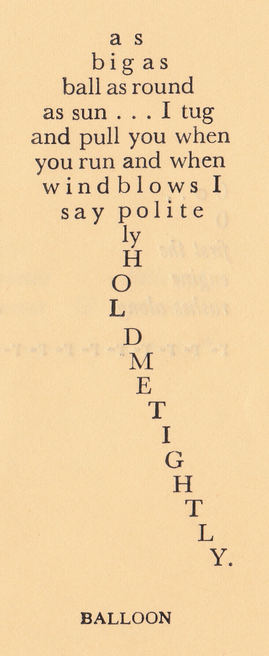
In 1965 gaf Colleen Thibaudeau een alleraardigst boekje uit met de intrigerende titel ‘Lozenges’. Om daar maar mee te beginnen; een Lozenge (◊) is een ruitvormig leesteken dat nog maar weinig gebruikt wordt. De lozenge werd vroeger wel eens gebruikt om spaties aan te geven bij woorden waar onduidelijk was of deze aan elkaar hoorden of niet. In de huidige spelling is dit niet meer nodig.
Colleen Thibaudeau (1925 – 2012) was een Canadees dichteres en schrijfster van korte verhalen die in veel tijdschriften en magazines gedichten publiceerde. Behalve ‘Lozenges’ publiceerde ze nog de bundels ‘Ten Letters’ (1975), ‘My Granddaughters Are Combing Out Their Long Hair’ (1977), ‘The Martha Landscapes’ (1984), ‘The “Patricia” Album’ (1992) en ‘The Artemesia Book’ (1991).
Het boekje ‘Lozenges’ staat vol met gedichtjes in de vorm van een object en heeft dit ook als titel. Voorbeelden zijn een kroon, een trein, een hockeystick en een pop.
Hieronder twee voorbeelden van een ballongedicht en een kaarsgedicht.
.


Voor het hele boekje on-line ga je naar http://colleenthibaudeau.com/lozenges-poems-in-the-shape-of-things/
The complete idiot’s guide to writing poetry
Nikki Moustaki
.
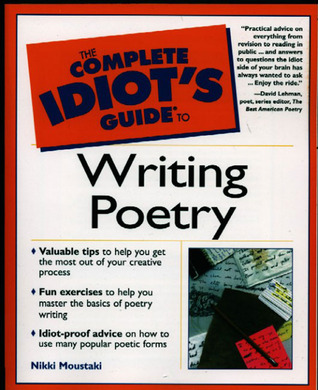
In 2001 publiceerde Nikki Moustaki ‘The complete Idiot’s Guide to writing Poetry’. Een boek over poëzie en het schrijven van poëzie, met tips en adviezen om meer uit het creatieve schrijfproces te halen en advies over te gebruiken vormen van poëzie.
Het boek is opgedeeld in een aantal hoofdstukken met verschillende paragrafen. Zo zijn de hoofdstukken getiteld: What is poetry and how do I write it, Opening the stanza’s door: entering poetry, Popular types of poems and how to write them, en Poetry and practicality.
Een leuk en leerzaam boek voopr elke dichter die verder wil komen, die zijn of haar grenzen wil verleggen of gewoon nieuwsgierig is naar een boek over poëzie.
Het boek is te koop voor het luttele bedrag van $1,99 (tweedehands) via Amazon.com maar je kunt het boek ook gratis als E-book lezen via Google books. (ga naar Google, boeken en typ de titel in).
Nikki Moustaki is is schrijfster van boeken over exotische vogels. Ze heeft een master degree in creative writing poetry van de New York University, een master of fine arts in creative writing poetry, van de Indiana University, master of fine arts in creative writing fiction, aan de New York University. Daarnaast heeft ze inmiddels verschillende prijzen gekregen voor haar literaire werk.
Na de tragedie van 11 september in New York schreef Nikki het gedicht ‘How to write a poem after september 11th’
.
How to write a poem after september 11th’
First: Don’t use the word souls. Don’t use the word fire.
You can use the word tragic if you end it with a k.
The rules have changed. The word building may precede
The word fall, but only in the context of the buildings falling
Before the fall, the season we didn’t have in Manhattan
Because the weather refused, the air refused . . .
Don’t say the air smelled like smoldering desks and drywall,
Ground gypsum, and something terribly organic,
Don’t make a metaphor about the smell, because it wasn’t
A smell at all, but the air washed with working souls,
Piling bricks, one by one, spreading mortar.
Don’t compare the planes to birds. Please.
Don’t call the windows eyes. We know they saw it coming.
We know they didn’t blink. Don’t say they were sentinels.
Say: we hated them then we loved them then they were gone.
Say: we miss them. Say: there’s a gape. Then, say something
About love. It’s always good in a poem to mention love.
Say: If a man walks down stairs, somewhere
Another man is walking up. Say: He sits at his desk
And the other stands. He answers the phone and the other
Ends a call with a kiss. So, on a rainy dusk in some other
City of Commerce and Art, a mayor cuts a ribbon
With giant silver scissors. Are you writing this down?
Make the executives parade through the concourse,
Up the elevators, to the top, where the restaurant,
Open now for the first time, sets out a dinner buffet.
Press hard. Remember you’re writing with ashes.
Say: the phone didn’t work. Say: the bakery was out of cake,
The dogs in the pound howled. Say: the world hadn’t
Asked your permission to change. But you were asleep.
If only you had written more poems. If only you had written
More poems about love, about peace, about how abstractions
Become important outside the poem, outside. Then, then,
You could have squinted into the sky on September 11th
And said: thank you, thank you, nothing was broken today.
.

Plath en Hughes
Jij zegt het
.
Naar aanleiding van het boek ‘Jij zegt het’ van Connie Palmen (over het huwelijk van Sylvia Plath en Ted Hughes, beide dichters, de zelfmoord van Plath en het zwijgen van Hughes) wil ik hier graag een gedicht van beide plaatsen. Veel mensen kennen de namen van dit beroemde dichterspaar wel maar hun werk is vaak bij hen onbekend (zo was het bij mij ook). Daarom van Sylvia Plath het gedicht ‘Memoirs of a spinach-picker’ en van Ted Hughes het gedicht ‘The seven sorrows’.
.
Memoirs of a Spinach-Picker
They called the place Lookout Farm.
Back then, the sun
Didn’t go down in such a hurry. How it
Lit things, that lamp of the Possible!
Wet yet
Lay over the leaves like a clear cellophane,
A pane of dragonfly wing, when they left me
With a hundred bushel baskets on the edge
Of the spinach patch.
Bunch after bunch of green
Upstanding spinach-tips wedged in a circle—
Layer on layer, and you had a basket
Irreproachable as any lettuce head,
Pure leafage. A hundred baskets by day’s end.
Sun and sky mirrored the green of the spinach.
In the tin pail shaded by yellow paper
Well-water kept cool at the start of the rows.
The water had an iron taste, and the air,
Even, a tang of metal.
Day in, day out,
I bent over the plants in my leather-kneed
Dungarees, proud as a lady in a sea
Of prize roses, culling the fullest florets;
My world pyramided with laden baskets.
I’d only to set one foot in wilderness—
A whole sea of spinach-heads leaned to my hand.
.

The Seven Sorrows
The first sorrow of autumn
Is the slow goodbye
Of the garden who stands so long in the evening-
A brown poppy head,
The stalk of a lily,
And still cannot go.
The second sorrow
Is the empty feet
Of a pheasant who hangs from a hook with his brothers.
The woodland of gold
Is folded in feathers
With its head in a bag.
And the third sorrow
Is the slow goodbye
Of the sun who has gathered the birds and who gathers
The minutes of evening,
The golden and holy
Ground of the picture.
The fourth sorrow
Is the pond gone black
Ruined and sunken the city of water-
The beetle’s palace,
The catacombs
Of the dragonfly.
And the fifth sorrow
Is the slow goodbye
Of the woodland that quietly breaks up its camp.
One day it’s gone.
It has only left litter-
Firewood, tentpoles.
And the sixth sorrow
Is the fox’s sorrow
The joy of the huntsman, the joy of the hounds,
The hooves that pound
Till earth closes her ear
To the fox’s prayer.
And the seventh sorrow
Is the slow goodbye
Of the face with its wrinkles that looks through the window
As the year packs up
Like a tatty fairground
That came for the children.
.




 ZICHTBAAR ALLEEN