Site-archief
Let America Be America Again
Langston Hughes
.
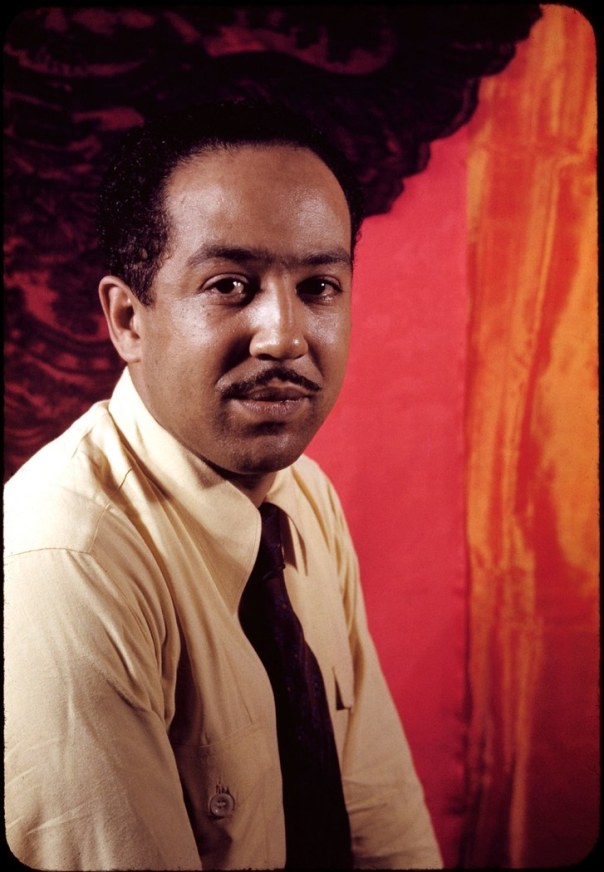
Over Langston Hughes (1902 – 1967) schreef ik al eerder maar ik werd opnieuw op een gedicht van hem opmerkzaam gemaakt toen ik in ‘Waarom Amerikanen niet lopen’ een passage over dit betreffende gedicht las. In dit geval gaat het om het gedicht ‘Let America Be America Again’. Zoals Arjen van Veelen in zijn boek schrijft, lijkt dit wat op de term die Trump gebruikt (make America great again) maar in dit geval gaat het om een heel ander onderwerp. Dit gedicht, geschreven in 1935, gaat over de Amerikaanse droom, dat deze droom nooit heeft bestaan voor de Amerikaan uit de lower-class, zwart, wit of gekeurd. En over de vrijheid en gelijkheid waar elke immigrant in de VS ooit op heeft gehoopt maar nooit heeft gekregen. De Verenigde staten staat voor een land waar alles mogelijk is, maar hebzucht en corruptie beletten gewone mensen vooruit te komen. Het gedicht is een contrast tussen wat Amerika hoopt te zijn en wat Hughes en anderen hebben meegemaakt
.
Let America Be America Again
.
Let America be America again.
Let it be the dream it used to be.
Let it be the pioneer on the plain
Seeking a home where he himself is free.
.
(America never was America to me.)
.
Let America be the dream the dreamers dreamed —
Let it be that great strong land of love
Where never kings connive nor tyrants scheme
That any man be crushed by one above.
.
(It never was America to me.)
.
O, let my land be a land where Liberty
Is crowned with no false patriotic wreath,
But opportunity is real, and life is free,
Equality is in the air we breathe.
.
(There’s never been equality for me,
.
Nor freedom in this “homeland of the free.”)
Say, who are you that mumbles in the dark?
.
And who are you that draws your veil across the stars?
I am the poor white, fooled and pushed apart,
.
I am the Negro bearing slavery’s scars.
I am the red man driven from the land,
I am the immigrant clutching the hope I seek —
And finding only the same old stupid plan
Of dog eat dog, of mighty crush the weak.
.
I am the young man, full of strength and hope,
Tangled in that ancient endless chain
Of profit, power, gain, of grab the land!
Of grab the gold! Of grab the ways of satisfying need!
Of work the men! Of take the pay!
Of owning everything for one’s own greed!
.
I am the farmer, bondsman to the soil.
I am the worker sold to the machine.
I am the Negro, servant to you all.
I am the people, humble, hungry, mean —
Hungry yet today despite the dream.
Beaten yet today–O, Pioneers!
I am the man who never got ahead,
The poorest worker bartered through the years.
.
Yet I’m the one who dreamt our basic dream
In the Old World while still a serf of kings,
Who dreamt a dream so strong, so brave, so true,
That even yet its mighty daring sings
In every brick and stone, in every furrow turned
That’s made America the land it has become.
O, I’m the man who sailed those early seas
In search of what I meant to be my home —
For I’m the one who left dark Ireland’s shore,
And Poland’s plain, and England’s grassy lea,
And torn from Black Africa’s strand I came
To build a “homeland of the free.”
.
The free?
.
Who said the free? Not me?
Surely not me? The millions on relief today?
The millions shot down when we strike?
The millions who have nothing for our pay?
For all the dreams we’ve dreamed
And all the songs we’ve sung
And all the hopes we’ve held
And all the flags we’ve hung,
The millions who have nothing for our pay —
Except the dream that’s almost dead today.
.
O, let America be America again —
The land that never has been yet —
And yet must be–the land where every man is free.
The land that’s mine — the poor man’s, Indian’s,
Negro’s, ME —
Who made America,
Whose sweat and blood, whose faith and pain,
Whose hand at the foundry, whose plow in the rain,
Must bring back our mighty dream again.
.
Sure, call me any ugly name you choose —
The steel of freedom does not stain.
From those who live like leeches on the people’s lives,
We must take back our land again,
America!
.
O, yes,
I say it plain,
America never was America to me,
And yet I swear this oath —
America will be!
.
Out of the rack and ruin of our gangster death,
The rape and rot of graft, and stealth, and lies,
We, the people, must redeem
The land, the mines, the plants, the rivers.
The mountains and the endless plain —
All, all the stretch of these great green states —
And make America again!
.
Tinder
Seamus Heaney
.
Afgelopen week zat ik wat in de bundel ‘Opened Ground, Poems 1966 – 1996’ van Seamus Heaney te lezen toen ik het gedicht ‘Tinder’ tegen kwam. Nu komt dit gedicht oorspronkelijk uit de bundel ‘Wintering Out’ uit 1972. In 1969 en 1970 bracht Heaney een sabbatical door in Berkeley (Verenigde Staten) op de University of California waar hij de gedichten uit deze bundel schreef.
Mijn oog viel op een gedicht getiteld ‘Tinder’ omdat het woord Tinder tegenwoordig bij heel veel mensen zo’n heel andere betekenis heeft gekregen (dating app). De juiste titel is eigenlijk ‘A Northern Hoard 5. Tinder’ maar in ‘Opened Ground’ staat het onder de titel ‘Tinder’ wat tondel betekent, licht ontvlambaar materiaal om vuur mee te maken. En dat past dan weer wel aardig bij een dating app.
.
Tinder
(from a Northern Hoard)
.
We picked flints,
Pale and dirt-veined,
.
So small finger and thumb
Ached around them;
.
Cold beads of history and home
We fingered, a cave-mouth flame
.
Of leaf and stick
Trembling at the mind’s wick.
.
We clicked stone on stone
That sparked a weak flame-pollen
.
And failed, our knuckle joints
Striking as often as the flints.
.
What did we know then
Of tinder, charred linen and iron,
.
Huddled at dust in a ring,
Our fists shut, our hope shrunken?
.
What could strike a blaze
From our dead igneous days?
.
Now we squat on cold cinder,
Red-eyed, after the flames’ soft thunder
.
And our thoughts settle like ash.
We face the tundra’s whistling brush
.
With new history, flint and iron,
Cast-offs, scraps, nail, canine.
.

Processed with VSCOcam with f2 preset
De beste Amerikaanse dichter
Elisabeth Bishop
.
Mensen zijn gek op lijstjes, ik ook. Op de website https://www.ranker.com/list/best-american-poets/ranker-books staat een overzicht van de beste Amerikaanse dichters, opgesteld door het publiek door simpelweg te stemmen op de favoriete dichter. Op zichzelf geen verrassend rijtje, de nummers 1 t/m 10 zijn allemaal heel bekende dichters (al staat E.E. Cummings natuurlijk op een 7e plaats te laag en staan zowel Bob Dylan met een 35ste plek en Jim Morrison op een 82ste plek in de lijst als lieddichters) maar de eerste voor mij onbekende dichter staat al op plek nummer 13: Elisabeth Bishop.
Bishop (1911-1979) was dichter en schrijfster. Bishops werk wordt vaak geschaard onder lesbische- of vrouwenpoëzie, maar zelf wilde ze van deze categorisering niets weten. Van een feministische inslag is ook weinig te merken. Haar gedichten zijn redelijk conventioneel van stijl en kenmerken zich door een hoge sensibiliteit, waarbij ze zich altijd kwetsbaar opstelt. Steeds heeft ze veel oog voor detail en kleinigheden. Haar werk werd vele malen onderscheiden, onder andere met de Pulitzerprijs voor poëzie in 1956, de National Book Award voor poëzie in 1970 en de National Book Critics Circle Award in 1976.
Hoewel ze moeilijk rond kon komen van haar schrijven reisde Bishop veel. Zo woonde ze van 1951 tot en met 1966 in Brazilië waar ze beïnvloed werd door dichters als Octavio Paz en Carlos Drummond de Andrade. Het gedicht Seascape is duidelijk tijdens één van haar reizen geschreven.
.
Seascape
.
This celestial seascape, with white herons got up as angels,
flying high as they want and as far as they want sidewise
in tiers and tiers of immaculate reflections;
the whole region, from the highest heron
down to the weightless mangrove island
with bright green leaves edged neatly with bird-droppings
like illumination in silver,
and down to the suggestively Gothic arches of the mangrove roots
and the beautiful pea-green back-pasture
where occasionally a fish jumps, like a wildflower
in an ornamental spray of spray;
this cartoon by Raphael for a tapestry for a Pope:
it does look like heaven.
But a skeletal lighthouse standing there
in black and white clerical dress,
who lives on his nerves, thinks he knows better.
He thinks that hell rages below his iron feet,
that that is why the shallow water is so warm,
and he knows that heaven is not like this.
Heaven is not like flying or swimming,
but has something to do with blackness and a strong glare
and when it gets dark he will remember something
strongly worded to say on the subject.
.

Lou Reed
Laurie Anderson
.
Ik ken de Amerikaanse experimentele performance-kunstenares, dichter en musicus Laurie Anderson (1947) vooral van haar hitsingle (en enige single die in Nederland bekend werd) ‘O Superman’ uit 1981. In 2008 trouwde zij met Lou Reed met wie ze tot zijn dood in 2013 samen woonde in New York.
‘O Superman’ is oorspronkelijk een cover van de aria ‘Ô Souverain, ô juge, ô père’ uit Jules Massenets opera ‘Le Cid’. Het lied begint ook met een vergelijkbare tekst, de stanza (O Superman / O Judge / O Mom and Dad) komt overeen met Massenets intro. Daarna volgt een telefoongesprek tussen de hoofdpersoon en een geheimzinnige stem aan de andere kant van de lijn, die eerst de moeder van de hoofdpersoon lijkt te zijn maar zich later ontpopt als ‘De Hand Die Neemt’. De stem heeft ook beschikking over lange, elektronische en petrochemische armen. Grote invloeden zijn er verder te horen van Einstein on the Beach van Philip Glass en Warm Leatherette van The Normal. Het lied refereert daarnaast aan thema’s zoals de Tao en telecommunicatie.
De tekst ontleent enkele bekende citaten en uitspraken (althans, voor Amerikanen), zoals de zin ‘Neither snow nor rain nor gloom of night shall stay these couriers from the swift completion of their appointed rounds‘, destijds de slogan van de toenmalige Amerikaanse PTT.
.
O Superman. O judge. O Mom and Dad. Mom and Dad
O Superman. O judge. O Mom and Dad. Mom and Dad
Hi. I’m not home right now. But if you want to leave a
Message, just start talking at the sound of the tone
Hello? This is your Mother. Are you there? Are you coming home?
Hello? Is anybody home? Well, you don’t know me, but I know you
And I’ve got a message to give to you
Here come the planes
So you better get ready. Ready to go. You can come
As you are, but pay as you go. Pay as you go
And I said: OK. Who is this really? And the voice said:
This is the hand, the hand that takes. This is the
Hand, the hand that takes
This is the hand, the hand that takes. This is the
Hand, the hand that takes
This is the hand, the hand that takes
Here come the planes
They’re American planes. Made in America
Smoking or non-smoking?
And the voice said: Neither snow nor rain nor gloom
Of night shall stay these couriers from the swift
Completion of their appointed rounds
Cause when love is gone, there’s always justice
And when justice is gone, there’s always force
And when force is gone, there’s always Mom. Hi Mom!
So hold me, Mom, in your long arms. So hold me
Mom, in your long arms
In your automatic arms. Your electronic arms. In your arms
So hold me, Mom, in your long arms
Your petrochemical arms. Your military arms
In your electronic arms
.

Haat gedicht
Julie Sheehan
.
Heel veel gedichten gaan over de liefde, over mooie momenten, herinneringen en fraaie zaken maar over haat gaan gedichten maar zelden. De Amerikaanse dichter Julie Sheehan schreef in haar bundel ‘Orient point’ uit 2006 een prachtig Haat gedicht getiteld ‘Hate poem’.
Op haar website http://juliesheehan.com/about/hate-poem/ schrijft ze over dit gedicht: This is not the story behind the hate—there is no story behind the hate, or if there is, I’m not telling. Instead, I have an observation, one that has probably occurred to many: hate and love can be described in the same, outlandish, hyperbolic and indistinguishable terms, probably because hate and love require the same degree of passionate intensity. Don’t say Yeats didn’t warn us, but it may be that hate and love are the same thing. Surely both are equally capable of mass destruction.
Kortom, als je de woorden ‘hate’ veranderd in ‘love’ dan heb je ineens een gedicht vol passie over liefde. Gaat het toch weer over de liefde.
.
Hate poem
.
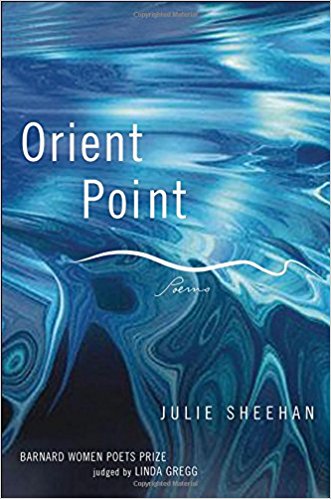

Foto: Kelly Ann Smith
Tegen de afgrond
Dirk van Bastelaere
.
Ik ruim mijn kast op. Dat is hard nodig want ik heb nog nauwelijks plaats voor mijn (nieuwe) dichtbundels. Tussen alle boeken vond ik ook nog een tijdschrift ‘Boek’ uit 2007. Waarom ik dat bewaard heb is me een raadsel, er staat hoegenaamd vrijwel niets over poëzie in behalve een klein stukje over de Week van de poëzie en de VSB poëzie prijs. Grappig om te lezen is dat de Week van de poëzie in 2007 van 21 tot en met 27 april liep (synchroon met de Poetry month in de VS) terwijl deze week inmiddels naar januari is ‘verhuisd’.
In dat stukje staan ook de genomineerde dichters waaronder Dirk van Bastelaere (1960) met zijn bundel ‘De voorbode van iets groots’. De VSB poëzieprijs won hij niet dat jaar, wel de Jan Campert prijs. Uit een andere bundel ‘Hartswedervaren’ uit 2000 het gedicht ‘Tegen de afgrond’ waaruit duidelijk het post moderne karakter van zijn poëzie blijkt.
.
Tegen de afgrond
Dat ik je aanspreek,
stom hart,
is natuurlijk complete waanzin, je bent
een generiek gegeven uit de cultuurgeschiedenis.
Dat betekent: een sterrennevel,
drijvende paddesnoeren, een parcours d’accidents
een zon die in het zwart verkeert,
napalm, Reihung, een nevengeschikte wereld
en we schrijven entropie.
Het is een woord,
hart,
tegen de wereld. Net zo goed kan ik tegen
de afgrond gaan schreeuwen, een canyon waarlangs
op zorgvuldige plaatsen
een houten framepje werd opgesteld
met de vermelding Take Pictures Here. KODAK
.


Paterson
Ron Padget en The New York School
.
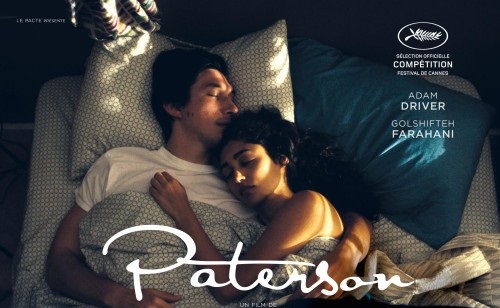
Op Facebook las ik in een stuk van Marja van Rossum over de film ‘Paterson’ van Jim Jarmusch. Nu staat deze film op mijn verlanglijstje van films die ik nog moet gaan zien maar na het stuk van Marja ga ik de film snel zien. In deze film draait het om een buschauffeur die poëzie gebruikt om de alledaagse routine te doorbreken. Uit het stuk van Marja begrijp ik dat poëzie wordt gebruikt van o.a. Ron Padgett zoals ook het gedicht ‘Love Poem’ hieronder. Padget maakte deel uit van de The New York School.
Critici betoogden dat het werk van The New York School een reactie was op de Confessionalist beweging in de poëzie van die tijd (de jaren ’50 en ’60 van de vorige eeuw). De onderwerpen van hun poëzie was vaak licht, gewelddadig of observerend, terwijl hun schrijfstijl vaak werd omschreven als kosmopolitisch en die van wereldreizigers. De dichters schreven vaak in een directe en spontane manier die doet denken de zogenaamde ‘stroom van bewustzijn’ schrijven, vaak met behulp van levendige beelden. Ze hebben zich gebaseerd op inspiratie uit het surrealisme en de hedendaagse avant-garde kunststromingen, in het bijzonder de action painting van hun vrienden in de kunstscene van New York City zoals Jackson Pollock en Willem de Kooning.
Dichters die vaak geassocieerd worden met de The New York School zijn John Ashbery, Frank O’Hara, Kenneth Koch, James Schuyler, Barbara Guest, Ted Berrigan, Bernadette Mayer, Alice Notley, Kenward Elmslie, Frank Lima, Lewis Warsh, Tom Savage, Joseph Ceravolo en Ron Padgett.
Van de laatste het gedicht ‘Love Poem’ uit de film ‘Paterson’ (met dank aan Marja van Rossum).
Love Poem
.
We have plenty of matches in our house.
We keep them on hand always.
Currently our favourite brand is Ohio Blue Tip,
though we used to prefer Diamond Brand.
That was before we discovered Ohio Blue Tip matches.
They are excellently packaged, sturdy
little boxes with dark and light blue and white labels
with words lettered in the shape of a megaphone,
as if to say even louder to the world,
„Here is the most beautiful match in the world
its one-and-a-half inch soft pine stem capped
by a grainy dark purple head, so sober and furious
and stubbornly ready to burst into flame,
lighting, perhaps, the cigarette of the woman you love,
for the first time, and it was never really the same
after that. All this will we give you.”
That is what you gave me, I
become the cigarette and you the match, or I
the match and you the cigarette, blazing
with kisses that smoulder toward heaven.
.

Foto: John Tranter
Gedicht op een ansichtkaart
International School of Tijanjin
.
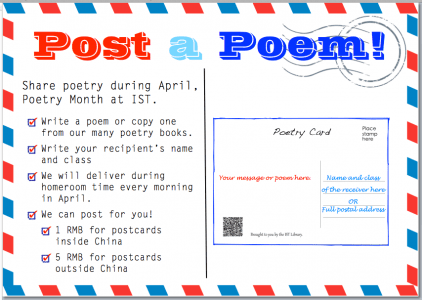
De bibliotheek van de IST (International School of Tijanjin) in China organiseerde in 2014 in ‘the poetry month’ (over gekomen vanuit de VS en van ouds in april) een mooi project met de naam Post a Poem.
Bij het Post a Poem station in de school, konden studenten en docenten een gedicht naar sturen naar een vriend bij IST of in de rest van de wereld. Iedereen kreeg een uitnodiging om uw eigen bericht met een gedicht te schrijven, of er een te kopiëren uit één van de vele gedichtenbundels in de bibliotheek.
Elke ochtend in april werd de kaarten door het bibliotheek personeel aan de IST ontvangers bezorgd tijdens het zogenoemde Homeroom uurtje. Wie een kaart wilde sturen aan iemand buiten de IST of zelfs buiten China kon dit ook doen, in dat geval werden de kaarten via de mail gestuurd.
Het versturen van de kaarten was gratis voor IST leerlingen en docenten, voor de rest van China koste het 1 RMB (€ 0,14) en voor buiten China 5 RMB ( € 0,70). Voor dit doel werd een eigen ansichtkaart gemaakt. Een mooi initiatief dat opvolging verdiend.
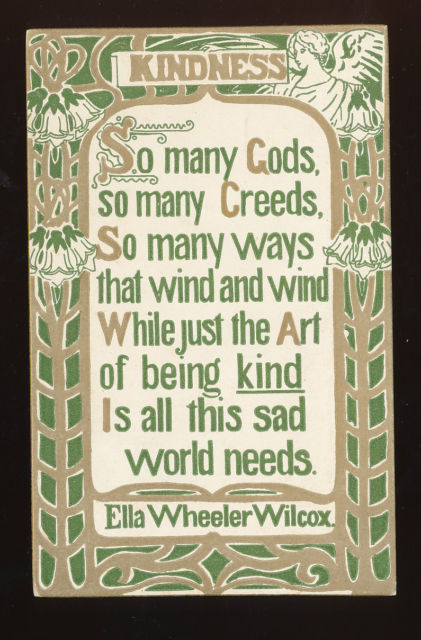
Hieronder de achterzijde van het voorbeeld dat gebruikt werd en een poem post card met een kort gedicht van Ella Wheeler Wilcox.
.
Peter Orlovsky
My bed is covered yellow
.
Peter Orlovsky (1933 – 2010) was een Amerikaans dichter. Hij was onderdeel van de Beat Generation en had een jarenlange relatie met collega-dichter Allen Ginsberg. Zijn werk verscheen in verschillende bladen en bloemlezingen.
Allen Ginsberg was ook de reden dat hij in 1957 begon met het schrijven van gedichten. Het stel woonde destijds in Parijs. Hij reisde later naar en door Europa, Afrika en India en woonde in de jaren ’60 in de New Yorkse kunstenaarswijk Lower East Side. In de jaren ’70 betrok hij een boerderij in de staat New York. Vanaf 1974 was hij als docent poëzie verbonden aan de ‘Jack Kerouac School of Disembodied Poetics’ in Boulder (Colorado).
In 1957 schreef Orlovsky in Parijs het gedicht ‘My bed is covered yellow’.
.
My Bed is Covered Yellow
My bed is covered yellow – Oh Sun, I sit on you
Oh golden field I lay on you
Oh money I dream of you
More, More, cried the bed – talk to me more –
Oh bed that taked the weight of the world –
all the lost dreams laid on you
Oh bed that grows no hair, that cannot be fucked
or can be fucked
Oh bed crumbs of all ages spiled on you
Oh yellow bed march to the sun whear yr journey will be done
Oh 50 lbs. of bed that takes 400 more lbs-
how strong you are
Oh bed, only for man & not for animals
yellow bed when will the animals have equal rights?
Oh 4 legged bed off the floor forever built
Oh yellow bed all the news of the world
lay on you at one time or another
.

Orlovsky en Ginsberg
Met dank aan Boppin.com




 ZICHTBAAR ALLEEN
Marilyn Monroe
10 dec
Geplaatst door woutervanheiningen
Fragments: Poems, Intimate Notes, Letters
.
In 2012 kwam het boek ‘Fragments: Poems, Intimate Notes, Letters’ geschreven door actrice Marilyn Monroe en samengesteld door Stanley Buchtal en Bernard Comment uit. De bundel bevat een verzameling gedichten, epigrammen, citaten en filosofische gedachten en stukjes geschreven door Norma Jeane Mortensen (geboortenaam) of Marilyn Monroe zoals de wereld haar zou leren kennen. De meeste van haar gedichten zijn vrij korte, vrije composities maar ze gebruikt ook van tijd tot tijd eindrijm. Ze was een lyrische dichter, meestal beginnend ‘in media rest'(waarbij je midden in een verhaal valt), zonder inleidende informatie. Een aantal van haar gedichten zijn in de vorm van een soort belijdenispoëzie (waarbij ze dingen opbiecht), terwijl anderen eerlijke en scherpe observaties zijn over het leven in het algemeen. Weer andere zijn ontroerend zoals het volgende gedicht waarin ook een zekere ironie is opgenomen:
.
I could have loved you once
And even said it
But you went away;
When you came back it was too late
And love was a forgotten word.
Remember?
.
Of dit volgende gedicht waarin ze veel zwaarmoediger klinkt.
.
O, Time
Be Kind
Help this weary being
To forget what is sad to remember …
Loose my loneliness,
Ease my mind,
While you eat my flesh.
.
Een groot aantal van de epigrammen, gedichten en stukjes tekst uit het boek komen van servetten of menukaarten van hotels en restaurants waar ze verbleef. Een aantal is nog steeds te zien op deze plekken. Hieronder een voorbeeld van de menukaart van het Waldorf Astoria Hotel in New York.
.
Voor wie graag meer van Marilyn Monroe wil lezen en bekijken, op de website http://www.thehypertexts.com/Marilyn%20Monroe%20Poet%20Poetry%20Picture%20Bio.htm staan behalve veel van haar gedichten ook een groot aantal minder bekende maar prachtige foto’s van deze prachtige maar trieste ster.
.
Dit delen:
Geplaatst in Dichtbundels, Favoriete dichters, websites over poëzie
Een reactie plaatsen
Tags: 2012, actrice, algemeen, Amerikaans, Astoria Hotel, belijdenispoëzie, Bernard Comment, biecht, boek, book, bundel, citaten, dichtbundel, dichter, eerlijk, epigrammen, filmster, filosofische gedachten, filosofische stukjes, Fragments: Poems Intimate Notes Letters, geboortenaam, gedicht, gedichten, hotels, in media rest, ironie, Leven, Marilyn Monroe, menukaarten, New York, Norma Jeane Mortensen, ontroerend, poëzie, poem, poems, poet, poetry, restaurants, samenstellers, scherpe observaties, servetten, Stanley Buchtal, teksten, The Waldorf Astoria Hotel, verzameling, VS, zwaarmoedig